
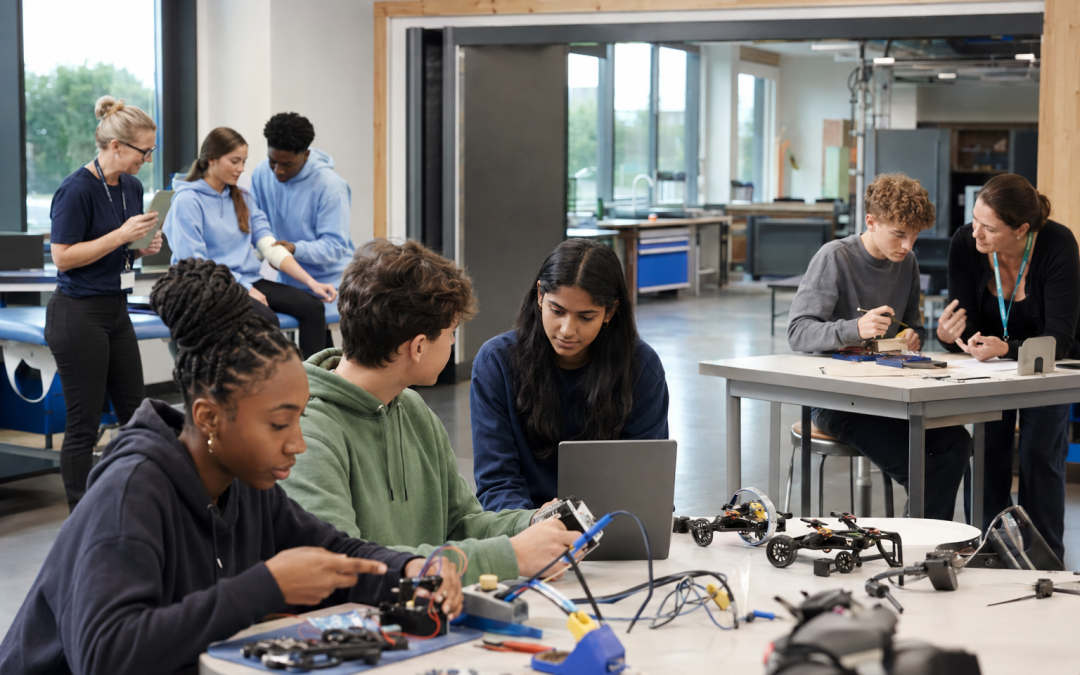
In this article, Christine Edwards QTLS explores how earlier technical education could strengthen vocational confidence, employability and progression, and why navigation, transition and collaboration will determine whether the promise of “no dead ends” becomes a lived reality for young people.
Earlier technical pathways could give young people greater confidence, stronger employability skills and a clearer connection between education and work. But realising that opportunity will require more than creating new routes.
The Government’s ambition to give young people greater access to technical education from the age of 14 could represent a significant shift in how we prepare them for adult life and work.
For too long, vocational and technical education has often become visible only after a young person has struggled within a predominantly academic route, or when decisions about their post-16 destination are already pressing.
Earlier exposure could change that.
It could enable young people to experience practical and technical learning before they are expected to make high-stakes choices. It could help them understand how knowledge is used in different occupations, develop confidence through meaningful activity and see skilled employment as an ambitious pathway rather than a second-best alternative.
It could also begin to address something employers have been saying for years: too many young people arrive in the workplace without sufficient understanding of professional expectations, communication, teamwork or how to apply their Maths, English and Digital Skills in real situations.
This is therefore not simply an opportunity to create more technical qualifications.
It is an opportunity to connect learning, employability and progression more coherently.
But opportunity will not organise itself.
A stronger connection between education and work
The Greater Manchester Baccalaureate, or MBacc, is already testing aspects of this approach.
As a Greater Manchester initiative, the MBacc is designed to connect technical education with the region’s growth sectors and routes into good local employment. The developing MBacc Award brings together five elements: technical learning, work experience, employer encounters, digital enrichment and careers conversations.
Across the wider model, these experiences are intended to help young people develop technical, digital and transferable skills and understand where those capabilities could lead.
The MBacc should not be confused with a confirmed national qualification or programme. It is currently a Greater Manchester model. If the Government’s wider ambitions for technical pathways from age 14 are developed nationally, they may take a different form or be adapted by different areas to reflect their own economies and communities.
However, the underlying principle deserves attention.
Young people should be able to see a meaningful connection between what they learn, where that learning could take them and the contribution they could make through future work.
This matters nationally as Skills England assesses skills needs across the eight Industrial Strategy growth sectors, together with construction and health and social care, collectively referred to as IS8+2.
It matters locally because different areas experience different combinations of opportunity, skills shortages, demographic change and participation challenges. Local Skills Improvement Plans (LSIPs), combined authority strategies and detailed local intelligence can help schools and providers understand where demand is developing and where clearer routes into skilled employment are needed.
For training providers, colleges and employers, earlier technical pathways could create new possibilities for collaboration with schools and young people.
But that collaboration must amount to more than occasional workplace visits, promotional talks or an introduction to a list of shortage occupations.
Young people need authentic opportunities to explore what work involves, practise relevant skills, receive feedback and understand the progression available within and beyond an initial occupational interest.
Exploration, not premature commitment
At 14, many young people will not know which occupation they eventually want to enter.
That is not a weakness in the model, provided earlier technical education is designed as exploration rather than premature commitment.
A young person might initially be interested in engineering and later decide to pursue digital technology, construction or health. Another might discover through practical experience that their original choice is not right for them.
That does not make the experience wasted.
Communication, teamwork, problem-solving, reliability and digital confidence travel across occupations and sectors. So do the abilities to follow instructions, manage time, respond to feedback, work safely and adapt when something does not go to plan.
Earlier technical learning could therefore operate as a meaningful opportunity to explore. Young people could experience different forms of work, identify where their interests and strengths lie and develop capabilities that remain valuable even if their eventual destination changes.
For young people who have struggled to see themselves succeeding through predominantly academic learning, meaningful vocational activity may also create a different experience of competence.
It can help them recognise why knowledge matters, where it is used and what they are capable of doing with it.
Questions such as “Why am I learning this?” or “When will I ever use it?” become easier to answer when Maths, English and Digital Skills are connected to purposeful activity.
The value lies not only in preparing a young person for one particular occupation. It lies in helping them explore possibilities, develop transferable capabilities and approach their eventual transition with greater confidence.

Employability cannot remain an employer complaint
Employers regularly express concern that young people are not sufficiently prepared for the workplace.
They may point to difficulties with communication, confidence, teamwork, problem-solving, reliability or professional behaviour. They may also find that young people struggle to apply apparently familiar Maths, English or Digital Skills when the context changes.
These concerns should not be dismissed. But neither should employability be treated as a set of attributes that young people are simply expected to acquire somewhere before they arrive.
Employability must be intentionally developed.
Earlier technical and vocational learning creates an opportunity to weave these capabilities through meaningful tasks rather than teaching them as disconnected topics.
A young person might develop communication by explaining a process to a customer or colleague. They might apply Maths through measurement, costing, tolerances, scheduling or interpreting data. They might strengthen their English by following technical instructions, recording decisions or presenting a recommendation. Digital capability might be developed through the tools, systems and information used within a particular sector.
Just as importantly, young people can begin to understand workplace expectations while they still have structured opportunities to practise, make mistakes, reflect and improve.
Progress reviews can help them recognise the capabilities they are developing, consider how those capabilities transfer to other settings and adapt their plans as their confidence, interests and ambitions evolve.
That can make the eventual transition into further education, an apprenticeship or employment feel less like stepping into an unfamiliar world.
It can build vocational competence, but also vocational confidence.
Local relevance must not become local limitation
Connecting education to local and national economic priorities makes sense.
Young people should know where opportunities are growing. They should understand which skills employers need and be able to see realistic pathways into secure, skilled and meaningful work.
But there is a tension that needs careful attention.
Local labour-market intelligence should expand what young people can see. It should not determine what adults believe they should become.
At 14, young people are still forming their identities and discovering what they enjoy, where they succeed and what might be possible. Their decisions are influenced by the information available to them, the confidence and knowledge of parents and carers, what their school visibly values, previous experiences of learning and the assumptions others make about their capability.
For some young people, particularly those with special educational needs and disabilities (SEND), social, emotional and mental health needs (SEMH), lower prior attainment or experience of disadvantage, technical education may be presented as what is considered “realistic” rather than as an ambitious choice.
That would reproduce an old hierarchy beneath new language.
A young person who is not academically inclined should be able to choose a vocational pathway because it allows them to learn differently, experience success and develop valuable expertise. That is very different from being directed towards it because others have already decided which opportunities are available to them.
Parity cannot simply be declared through policy. It has to be experienced by the learner.
A technical pathway is genuinely equal when a young person can enter it with confidence, see where it could lead and continue progressing without discovering that a decision made at 14 has quietly closed later doors.
Earlier choice therefore requires stronger exploration, impartial guidance and visible opportunities to reconsider.
The promise of “no dead ends” will depend not only on the pathways available, but on whether movement between them is genuinely possible.
Navigation is part of the infrastructure
Creating more routes does not automatically make a system easier to navigate.
Young people and their families need to understand:
– what different pathways involve;
– how they connect to further study, apprenticeships, employment and higher technical education;
– which choices preserve or restrict later options;
– what progression looks like beyond the first qualification or job;
– how transferable skills can support movement between sectors;
– how to change direction without unnecessary repetition or penalty.
This is why careers education, information, advice and guidance (CEIAG) cannot sit at the edge of technical reform.
CEIAG is part of the infrastructure that makes opportunity visible and navigable.
Schools, providers and employers will need a shared understanding of the pathways being created. Parents and carers will need accessible information that allows them to discuss technical routes with the same confidence often attached to established academic progression.
Providers will also need to think beyond recruitment.
If schools are introducing young people to technical routes earlier, colleges and training providers have an opportunity to contribute their vocational expertise, employer relationships and understanding of progression.
They will also need to consider how they communicate with younger learners, work alongside schools and help families understand an increasingly complex landscape.
The question is not simply whether a pathway exists.
It is whether the learner can see it, understand it, trust it and recognise where it might lead.

Transition is where the promise will be tested
Earlier technical engagement could strengthen the transition from school into further education, training or work.
But only if the transition itself is designed well.
Historically, information does not always travel effectively between schools, providers, employers and support services. Records may be transferred, but the receiving organisation may still lack a usable understanding of the young person.
It may not know:
– how the learner communicates;
– what helps them participate confidently;
– which adjustments have been effective;
– where confidence becomes fragile;
– what triggers anxiety or withdrawal;
– how their Maths, English and Digital Skills appear in practice;
– which vocational experiences have engaged them;
– what they want the next stage to make possible.
Effective transition is not simply the transfer of data.
It is the transfer of usable understanding.
This is particularly important for young people with SEND and/or SEMH, but it is not only an inclusion issue. Every young person carries experiences, expectations, strengths and uncertainties into a new environment.
When that understanding does not travel, the receiving organisation has to guess. Needs may be recognised late or misinterpreted. Confidence and participation can weaken. Attendance, behaviour or progress then becomes the visible problem, while the underlying transition failure remains unexamined.
The learner may be described as “not ready” when the system has failed to prepare itself to receive them.
The Education and Training Foundation’s Beyond the Label work provides a useful challenge here. Effective transition requires anticipation, continuity, co-design, capability, participation and progression.
Schools need to prepare young people for what comes next. Providers and employers must also prepare themselves for the young people who are coming.
Can young people change direction?
The ability to change direction will be one of the most important tests of the emerging system.
A change in route should not automatically be viewed as failure or indecision. It may be evidence that a young person has learned more about themselves, encountered a new possibility or developed ambitions that were not visible to them at 14.
High-quality progress reviews should help learners reflect on:
– what they have learned about themselves;
– which capabilities they are developing;
– where those capabilities could transfer;
– whether their current pathway still supports their ambitions;
– what further information or experience they need;
– what the next appropriate step might be.
Without this ongoing reflection, a route chosen at 14 risks becoming something to complete rather than a pathway that continues to respond to the learner.
Strong navigation does not end when an initial choice is made.
It continues through review, feedback, adaptation and progression.
The question “Can young people change direction without encountering avoidable dead ends?” should therefore sit at the centre of programme and pathway design.
A different way of working
The potential of earlier technical pathways is substantial.
They could help young people build confidence through practical success. They could create a clearer line of sight between education and future work. They could enable the contextualised development of Maths, English, Digital and employability skills.
They could also strengthen collaboration between schools, providers and employers, while giving national and local skills priorities a more visible connection to young people’s learning.
But realising that potential will require organisations to work differently.
Leaders should be asking:
– Can young people and their families see where every pathway could lead?
– Do learners have meaningful opportunities to explore before they are expected to commit?
– Are transferable employability, Maths, English and Digital capabilities intentionally developed through authentic vocational activity?
– Can young people change direction without encountering avoidable dead ends?
– Do progress reviews help learners recognise their developing capabilities and adapt their plans?
– Does usable understanding travel with the learner across school, provider and workplace boundaries?
– Are providers and employers prepared to receive and support younger entrants, or is readiness expected only from the young person?
– Are local skills priorities widening opportunity without placing a ceiling on aspiration?
The success of technical education reform will not be measured solely by the number of pathways created or how neatly they align with economic priorities.
It will be measured by whether young people can see those pathways, enter them with confidence, navigate them with support and continue progressing as their capabilities, circumstances and ambitions develop.
Earlier technical education could create a much stronger bridge between school, further learning and work.
But if there are genuinely to be no dead ends, we must design the navigation, connections and transitions as carefully as we design the routes themselves.
Creating Excellence supports education and training organisations to strengthen curriculum coherence, inclusive transition, CEIAG and workforce capability. If your organisation is reviewing how effectively learners are prepared for progression, and how ready your systems, staff and employer partners are to receive them, get in touch to explore where greater connection could make the difference.
Trackbacks/Pingbacks