

In this article, Christine Edwards QTLS explores why successful performance does not always mean that learning is secure. Drawing on experience in vocational education and evidence about teaching, assessment and effective support, she considers how educators can help learners retain knowledge, recognise their capabilities and apply what they know beyond familiar tasks. She also examines what this means for inclusion, apprenticeship end-point assessment and organisational quality.
When familiar skills become unfamiliar Mathematics
In 2003, shortly after I joined the further education and skills sector, I attended a session delivered through the Key Skills Support Programme. The group included vocational assessors working in health and social care and hairdressing. We were exploring Application of Number, and then we reached ratio.
I remember the reaction from some of the hairdressing assessors: groans, visible frustration and a sense that we had arrived at something difficult.
I was surprised. Hairdressers use ratios routinely when mixing colour and developer. One part of one product to two parts of another is an everyday occupational application of proportion. Angles, too, are present in cutting techniques.
Yet when familiar occupational knowledge was presented through Mathematical terminology, the response changed.
I could not know from that reaction whether the assessors lacked Mathematical understanding, confidence in the terminology or positive experiences of learning Mathematics. But it challenged an assumption I had made: that because people could use mathematical ideas within their vocational practice, they would automatically recognise those ideas in another form.
That experience has stayed with me. It raises a question that extends far beyond hairdressing.
If someone can use knowledge successfully in one situation, does that mean they recognise it, understand it and feel confident applying it elsewhere?
And what happens when learning that appeared secure is no longer readily available when somebody needs it?
When learning looks secure but isn’t
Think about teaching equivalent fractions. A learner initially struggles to understand why one-half is equivalent to two-quarters. Through explanation, visual representation, questioning and practice, they begin to understand. They can explain their reasoning and complete the activities successfully.
At the end of the session, there is meaningful evidence of progress.
Return several months later, however, and the picture may be different. The learner may recall the principle immediately, need a prompt or struggle to retrieve what they once understood.
That does not necessarily mean the original teaching failed. Understanding something at one point in time does not guarantee that it will remain readily available.
Coe and colleagues, in What Makes Great Teaching? identify reviewing previous learning, effective questioning, practice and scaffolding among important features of effective instruction. Questionmark’s ‘Assessments Through the Learning Process’ explores how retrieval and feedback can contribute to learning, rather than assessment serving only to record achievement. The implication is straightforward but demanding. Opportunities to revisit important knowledge should be designed into the curriculum, not left to chance.
This is not simply repeating the same activity. Learners need opportunities to retrieve knowledge, explain their thinking, encounter variation, receive feedback and connect earlier learning with new challenges.
Teaching something is an event. Securing learning is a process.
Contextualisation must make learning visible
Vocational contextualisation is fundamental to meaningful learning. An electrician uses calculations to solve occupational problems. A care practitioner uses English when recording accurate information and communicating sensitively. A hairdresser uses ratio when mixing products. Digital Skills run through many of these activities.
These are not incidental extras. They demonstrate the richness and complexity of vocational curricula.
But there is a difference between a skill being present in the curriculum and a learner recognising that they are using it.
If we embed Mathematics, English and Digital Skills so thoroughly that they become invisible, we may miss an opportunity to strengthen understanding, confidence and transfer.
A learner may calculate quantities correctly without recognising proportional reasoning. They may communicate effectively with customers yet describe themselves as poor at English. They may use workplace technology competently but lack confidence when asked about their digital capability.
We cannot assume that learners recognise the wider skills within a vocational task simply because their tutor can see them.
Effective contextualisation therefore needs to be deliberate. Educators can spotlight the Mathematics, English and Digital Skills already present; name them in accessible language; explain why they matter; and revisit them across different activities.
What calculation did you use there? Why does that communication approach work? Where else might you need that digital skill? What would change if the situation were different?
These conversations bring learning to life. They help learners see that their occupational experience contains valuable, transferable knowledge and skills. They also help vocational educators recognise the full breadth of what they teach.
That recognition can strengthen educators’ confidence too. A vocational specialist does not have to become a Mathematics or English specialist to make authentic applications visible, reinforce them appropriately and recognise when a learner needs additional teaching.
There is an important boundary here. Contextualising and reinforcing a skill is not the same as providing the specialist instruction required when its underlying principles have not been understood. Strong provision needs both vocational expertise and access to appropriate specialist support.
The aim is not to bolt isolated Mathematics, English or Digital exercises onto a vocational programme. It is to celebrate and deliberately develop the rich learning that is already there, while addressing gaps honestly.
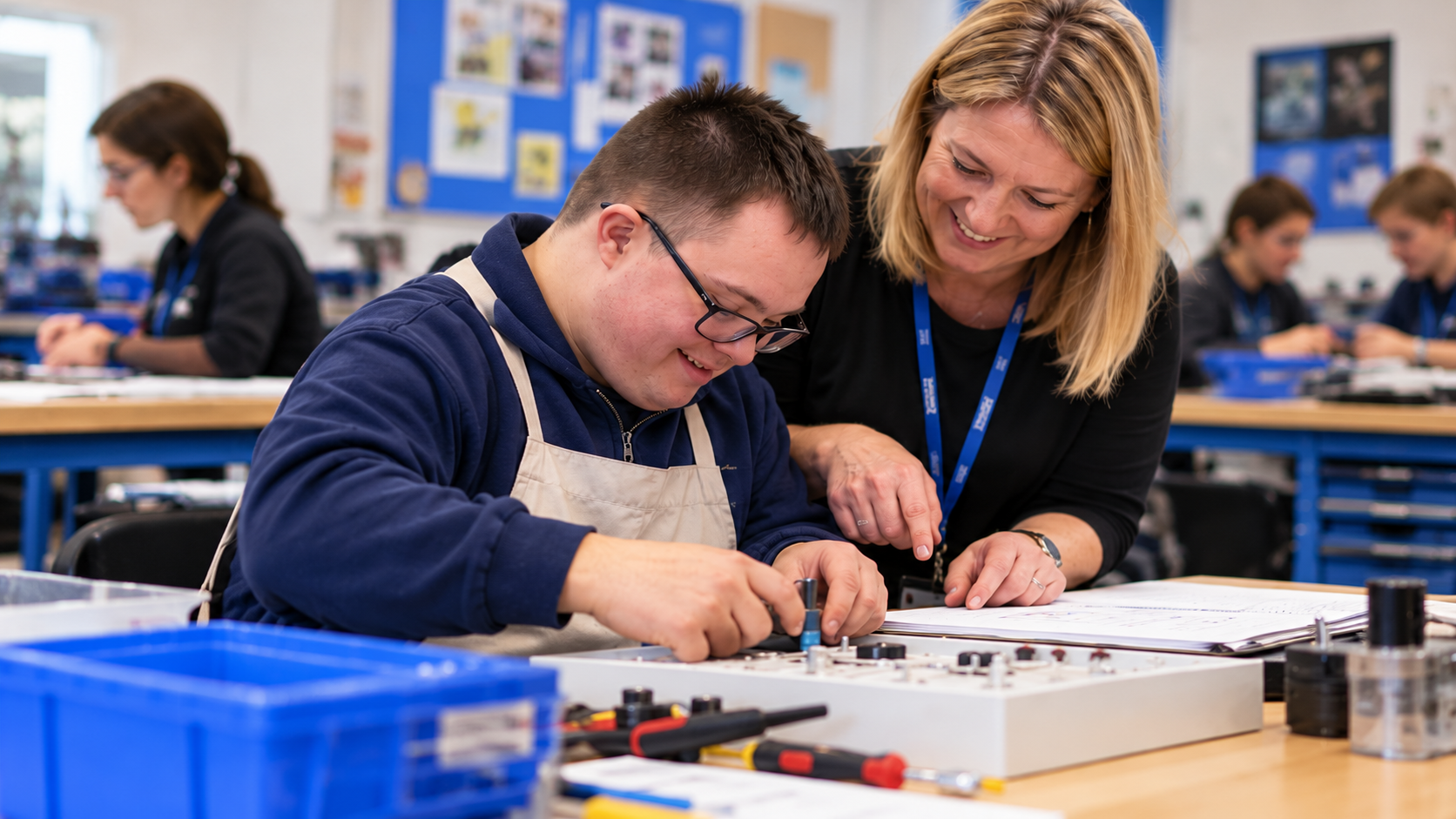
Inclusion changes how we understand secure learning
Learning does not become secure under identical conditions for every person.
Learners may face different barriers to accessing information, processing language, retaining sequences, managing cognitive load, communicating their understanding or applying knowledge in unfamiliar environments. Prior educational experiences, anxiety, confidence and the accessibility of teaching and assessment can also shape what someone is able to demonstrate.
These differences matter, including for learners with SEND and others who need additional or adapted support. But they should not lead us to confuse a barrier to demonstrating learning with an absence of capability.
A learner may understand a vocational process but struggle with dense written instructions. Another may need a visual sequence to organise a complex task. Someone else may demonstrate sound judgement through conversation but find a particular written format disproportionately difficult.
Inclusive practice asks us to examine both the learning and the conditions in which it is being demonstrated. Are we assessing the intended knowledge and skill, or are avoidable barriers obscuring it?
It also asks whether support helps learners develop understanding and agency over time.
Nesta and Osca’s Good and Bad Help: How Purpose and Confidence Transform Lives offers a useful perspective. Although its focus is wider than education, it highlights purposeful scaffolding, enabling conversations, tailored support and opportunities for people to act with growing confidence.
Support is not inherently evidence of insecure learning. Reasonable adjustments, assistive technology, accessible resources and human support may be essential and entirely appropriate, including in employment.
The question is whether support is responsive to the learner, helps them develop the intended capability and allows us to understand what they can do within the legitimate conditions of the task.
Independence should not be confused with being left without support. The goal is meaningful participation, secure understanding and increasing agency, with appropriate support where it remains necessary.

What does assessment really tell us?
Assessment helps establish what learners know, understand and can do. It informs teaching, identifies gaps and supports legitimate decisions about achievement and competence.
But different assessments answer different questions.
An assessment immediately after teaching provides evidence of performance at that point. It does not necessarily show what someone will remember months later. A familiar workplace task may demonstrate competence in that setting without showing whether the learner can adapt the same knowledge to a different problem.
Neither assessment is automatically invalid. The issue is whether the evidence supports the conclusion we draw from it.
The purpose of assessment therefore matters. Assessment for learning can reveal misconceptions and inform the next teaching decision; summative assessment establishes achievement against specified requirements. Both have value, but neither should be asked to prove more than the evidence can support.
Questionmark distinguishes diagnostic, formative and summative purposes and highlights retrieval practice and feedback. This aligns with assessment for learning: assessment should help learners and educators decide what needs to happen next, not merely record what happened already.
Assessment validity is particularly relevant when digital tools and AI can help produce convincing work. A polished response does not, by itself, tell us how much the learner understands. Can they explain their reasoning, justify their choices, recognise limitations and respond when the task changes?
That does not mean banning tools or insisting every assessment be completed without assistance. In many occupations, selecting and using tools responsibly is part of professional competence. It means being clear about what the assessment is intended to establish and whether the method provides appropriate evidence.
The same principle applies to authentic vocational assessment: the conditions and demands of the assessment should relate meaningfully to the capability being evaluated, while respecting the requirements of the qualification or standard.
Why this matters for apprenticeship end-point assessment
The stakes become particularly visible in apprenticeships.
An apprentice may have demonstrated knowledge and skills repeatedly during training, often with feedback, coaching and workplace support. At end-point assessment, however, they must demonstrate the knowledge, skills and behaviours required by their assessment plan, under the specified assessment conditions.
The precise requirements differ between apprenticeship standards and assessment methods. Some involve observation, professional discussion, projects, tests or other approaches. Permitted resources and reasonable adjustments also vary. Apprentices must demonstrate the required competence under the conditions set out in the applicable assessment plan, including any agreed reasonable adjustments. Independence must not be confused with an absence of appropriate, permitted support.
What remains important is that learning is sufficiently secure for apprentices to retrieve, explain and apply the required knowledge and skills when it matters. (Related article: When Answers Come Easily, Are We Losing the Will to Think?)
Preparation cannot simply mean rehearsing likely questions shortly before the assessment. Nor should it depend on whether a familiar trainer is present to prompt the next step.
Curriculum sequencing, planned retrieval, authentic practice, feedback and opportunities to explain decisions all contribute to readiness. So does ensuring apprentices understand the breadth of the standard and can recognise how their workplace experience connects to its requirements.
End-point assessment readiness should be built throughout the programme, not manufactured at the end.
From everyday practice to organisational quality
The Ofsted further education and skills inspection toolkit places emphasis on curriculum sequencing, building on previous learning and helping learners grasp, retain and apply knowledge.
That reinforces a question organisations should ask regardless of inspection: how do we know that learning is becoming secure?
Achievement rates, assessment records and positive feedback all matter. But they cannot, individually, answer every question about what learners retain, recognise or can transfer.
Leaders need to look at what happens across the learner journey.
– Are important concepts revisited?
– Do vocational and specialist educators understand where Mathematics, English and Digital Skills are being developed?
– Can learners explain the wider value of those skills?
– Do assessments reveal misconceptions early enough for teaching to respond?
– Are barriers to participation and demonstration being identified and addressed?
This builds on a question I explored in Before You Prescribe More CPD, Diagnose the Capability Gap: are we identifying whether people need knowledge, understanding, application or judgement before deciding what development to provide?
This also has implications for workforce development. Vocational educators need opportunities to understand the Mathematics, English and Digital demands of their curricula, recognise when they are reinforcing skills effectively and know when specialist expertise is required.
That is not an argument for asking every vocational educator to teach every subject. It is an argument for making the full curriculum visible, supporting collaboration and valuing the capabilities already present in occupational teaching.
Employers and workplace supervisors also have a part to play. Apprentices need opportunities to revisit and apply learning in authentic situations, including when circumstances, customers, equipment or problems change.
Learning that lasts is not the responsibility of one tutor or one assessment event. It is an organisational design and implementation question.

Retention, recognition and transfer: three connected questions
Across these examples, three questions can help organisations examine learning more closely.
Retention: Does learning last?
Can learners retrieve and use important knowledge after time has passed? Is revisiting it a deliberate part of curriculum planning?
Recognition: Do people recognise what they know and can do?
Are Mathematics, English and Digital capabilities made visible within vocational learning? Can learners explain the wider skills they are developing?
Transfer: Can people use learning when circumstances change?
Can they select, adapt and apply relevant knowledge beyond a rehearsed task or familiar setting?
These are not proposed as a new research model or a fixed sequence. They are connected questions, informed by established evidence and professional experience, that can make curriculum and quality discussions more searching.
They also help us avoid an unhelpful choice between academic knowledge and vocational practice. Secure capability needs both understanding and meaningful opportunities to use it.
Are we designing for completion, or for what comes next?
I still think about the hairdressing assessors in that Key Skills support session in 2003.
Not because it proved that the assessors lacked mathematical knowledge. It did not. It reminded me how easily we can assume that people recognise what they know simply because we can see it in their practice.
The same assumption can arise when a learner completes a fractions exercise successfully, an apprentice performs a familiar workplace task or an educator embeds Mathematics, English and Digital Skills without ever naming them.
Completion matters. Achievement matters. Qualifications matter. So do the inclusive conditions that make meaningful learning possible.
But their value is greater when the knowledge and skills behind them remain available, recognisable and useful beyond the immediate task.
For education and skills organisations, the challenge is to design curricula, teaching, support and assessment with that longer view in mind.
The real test of learning is not simply whether someone can demonstrate it today. It is whether that learning remains useful when they need it tomorrow.
What might this mean for your organisation?
Where does your organisation have evidence of immediate performance, and where can you see learning being retained, recognised and applied over time?
Are vocational Mathematics, English and Digital Skills visible to learners and educators, or are you assuming that embedding them is enough? Do your curriculum and assessment arrangements support secure learning, inclusive participation and readiness for what comes next?
At Creating Excellence, I work with education and skills organisations to examine the connections between curriculum design, inclusive practice, workforce capability and organisational quality. If these questions resonate with challenges you are exploring, I would welcome a conversation.
About the author
Christine Edwards QTLS is an Education Strategy and Professional Learning Consultant specialising in post-16 education, apprenticeships, Maths, English and Digital capability, inclusion, curriculum and quality improvement. Through Creating Excellence, she helps organisations translate strategy, evidence and professional learning into confident, consistent practice and better learner experiences.