

Maths Anxiety is often treated as something a learner brings into education. But what happens when curriculum, assessment, language and organisational decisions reinforce the fear already present? In this article Christine argues that rebuilding confidence and protecting participation require a whole-organisation approach, particularly as essential skill development is beginning to disappear from parts of post-16 provision.
Although the focus here is on Maths, the wider questions also apply to English and Digital Skills.
————————————————————-
“I’m just bad at Maths.”
It is a familiar statement across further education, adult learning and apprenticeships. Sometimes it is said quietly. Sometimes it is delivered as a joke before anybody else can expose the difficulty. At other times, it appears through avoidance: the learner who stops contributing, misses the Maths session, puts off an assessment or follows a familiar procedure without understanding why it works.
We often describe this as Maths Anxiety. But what are we actually seeing?
Maths Anxiety may begin through many different experiences. Previous failure, insecure knowledge, repeated assessment, family attitudes, disrupted education and the fear of being exposed in front of other people can all play a part.
But anxiety does not exist separately from the environment in which somebody is expected to learn.
Post-16 organisations may inherit a learner’s fear of Mathematics. What happens next can either begin to reduce the conditions that sustain that fear or reinforce everything the learner already believes about themselves.
That makes Maths Anxiety more than an individual difficulty. It can also be a participation and organisational signal.
We have tried to change the story before
This is not the first time the sector has confronted negative attitudes towards Maths.
Campaigns such as Gremlins, Get On and Move On tried to challenge the stigma surrounding weak literacy and numeracy. They encouraged adults to recognise the value of developing their skills and presented progress as something achievable rather than something from which people should hide.
The Skills Pledge strengthened the message that essential skills were not solely an individual responsibility. Employers and organisations also had a role in creating opportunities for people to learn and develop.
At the same time, work led by Malcolm Swann and others began to challenge established approaches to post-16 mathematics teaching. The emphasis shifted away from answer-getting, passive worksheets and teachers demonstrating a correct method for learners to reproduce. Greater attention was given to discussion, reasoning, collaboration, misconceptions and the connections between mathematical ideas.
This mattered because changing somebody’s relationship with Maths requires more than another explanation of the same procedure.
Self-efficacy helps us understand why. What people believe about their likelihood of succeeding can influence whether they attempt a task, persist when it becomes difficult or avoid it altogether. Growth-mindset thinking also challenged the assumption that mathematical ability is fixed.
Neither idea means telling an anxious learner to think positively or try harder. Belief changes when people experience learning differently. They need opportunities to make progress, recognise that progress, apply what they have learned and gradually trust that the success belongs to them.
The sector once invested significant energy in changing both the public story about Maths and the experience of learning it. We should be careful not to lose that lesson now.
Flexibility is not the same as irrelevance
In February 2025, the apprenticeship funding rules changed. Apprentices who began their programme aged 19 or over were no longer required to study towards and achieve English and Maths qualifications. Funded provision remained available where the apprentice did not already hold suitable equivalent qualifications and the employer agreed that English and/or Maths should form part of the training plan. In practice, however, that agreement was not always reached.
There were legitimate reasons for introducing that flexibility. An apprentice could be occupationally competent yet unable to complete their apprenticeship because of a separate English or Maths qualification requirement. Removing the exit requirement allowed those apprentices to progress to EPA. A standardised qualification requirement, not directly connected to the apprenticeship’s occupational standards, may not always represent the most appropriate response to an overall assessment of competence within set occupational expectations and operational needs.
But policy intention and implementation are not the same thing.
The change to the English and Maths exit requirements for apprentices aged 19 and over did not mean that Maths and English had ceased to matter. It removed a mandatory qualification requirement for some apprentices. It did not remove the Mathematics embedded naturally in work, progression and everyday decision-making.
Yet the message received in parts of the sector appears to have been much simpler:
“We don’t have to do Maths and English anymore.”
What saddens me is what I am beginning to see across parts of the sector. In some provision, Maths and English are not simply being delivered differently; they are beginning to disappear from the curriculum. Specialist roles and teams have been reduced or lost, while the difficulty of sustaining Functional Skills achievement can make provision appear to be a performance risk rather than an essential part of inclusion and capability.
That concern sits within a wider national pattern.
Research published by the Learning and Work Institute (September 2026) found that average real-terms annual spending on adult numeracy programmes was 37% lower across the first five years following skills devolution than during the three years before it. Over the longer period from 2016/17 to 2023/24, classroom-based adult Maths achievements fell by 53%.
This does not explain every local decision or establish that devolution caused the decline. It does, however, show a sustained contraction in the investment and achievement underpinning adult essential skills provision.
This is not happening because people no longer need Maths and English. It is happening, at least in part, because removing the requirement has made it easier to treat essential skill development as optional rather than essential.
I am not arguing that every apprentice should be forced through an identical qualification route. Flexibility can allow providers, employers and apprentices to agree development that is better matched to occupational need, starting point and future ambition. But flexibility only becomes inclusive when the capability, expertise and provision needed to exercise that choice still exist.
This exposes an uncomfortable question.
If an organisation’s commitment to Maths and English depends primarily on a funding rule or completion requirement, what happens when that requirement is removed?
A strong response to flexibility would be to assess what mathematical capability the apprentice needs, identify existing strengths and barriers, agree meaningful development with the employer and connect learning directly to competent work.
A weaker response is to assume that because the qualification is optional, the capability is unnecessary.
Removing a compliance requirement may create flexibility. It does not remove organisational responsibility.
Functional Skills is not the easy option
Part of the problem is the persistent assumption that Functional Skills is easier than GCSE Mathematics.
It is different, but different does not necessarily mean easier.
GCSE Mathematics develops and assesses a substantial body of mathematical knowledge, including the ability to reason and solve problems. Functional Skills places particular emphasis on selecting and applying mathematical knowledge in unfamiliar, purposeful contexts.
That application can be demanding.
A learner may know how to calculate a percentage when the method is clearly signposted. It does not necessarily follow that they will recognise when a percentage calculation is needed in a workplace problem.
They may be able to complete a ratio exercise but struggle to adapt a recipe, calculate staffing requirements, mix materials, interpret medication information or decide whether a financial offer represents good value.
I have seen young people arrive with a respectable GCSE Maths grade and then struggle with a Level 2 Functional Skills paper. The problem is not necessarily that they have forgotten every mathematical procedure. They may struggle to identify the Mathematics hidden inside the situation, decide what information matters and transfer knowledge from one context to another.
Conversely, adults who say they cannot ‘do Maths’ may already use complex mathematical thinking successfully at work or at home. They simply do not recognise that capability as “Maths” because it looks different from what they experienced at school.
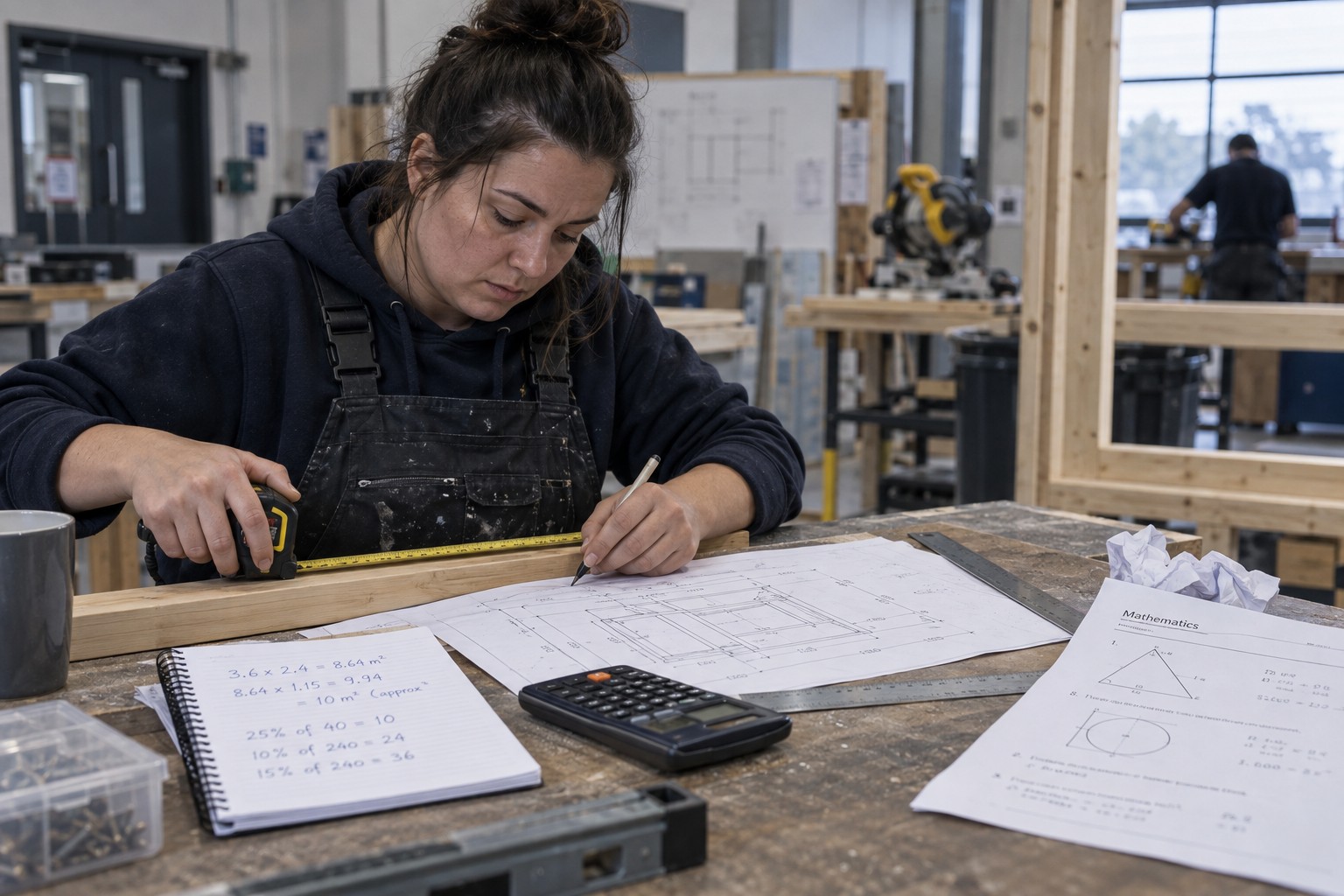
This distinction matters for Maths Anxiety.
If learners repeatedly experience Mathematics as disconnected procedures and high-stakes answers, they may interpret difficulty with application as further proof that they lack ability. If assessment repeatedly reveals what they cannot yet do without helping them recognise what they already know, it can reinforce the very identity we are trying to change.
Functional Mathematics should make capability visible. Poorly designed provision can make failure more visible instead.
When assessment recreates the problem
Initial and diagnostic assessment should help us understand a learner’s starting point. But assessment is not emotionally neutral.
Anxiety may be connected not only to the mathematical task itself, but to being slower than other people, making a mistake publicly, explaining an uncertain answer or admitting that something has not been understood.
For somebody returning to learning after a long absence or carrying memories of repeated failure, an entry test may recreate the experience they are already expecting. A low score can become confirmation: “I knew I couldn’t do it.”
The 2023 DfE systematic review of adult numeracy found examples of providers using welcoming initial interviews before formal diagnostic assessment. It also highlighted the danger of confusing an adult who is mathematically rusty with somebody who lacks the underlying knowledge.
However, the evidence needs to be handled carefully. The review focused specifically on adults aged 19 and over. Only four of the included studies addressed Maths Anxiety directly; it found no studies addressing the needs of adults with dyscalculia; and only limited adult SEND evidence.
We know enough to recognise the interaction between anxiety, confidence, previous experience, relevance and participation. We know much less about which interventions work reliably for which adults, in which contexts and over what period of time.
This does not mean abandoning assessment. It means being clearer about its purpose.
Are we assessing to allocate, label and satisfy a process? Or are we using assessment as part of a continuing conversation about prior knowledge, confidence, goals, misconceptions and support?
The same question applies to progress.
If Grade 4 or a Level 2 pass is the only progress that counts, learners may work for months without being able to see that anything has changed. They may understand more, participate more confidently, explain their reasoning, apply learning at work or recover after making a mistake, while still believing they are failing.
Confidence does not replace mathematical knowledge. But if progress remains invisible until the final qualification is achieved, some learners will disengage before they have enough evidence to revise what they believe about themselves.
Maths Anxiety is not only the Maths Specialist’s problem
When an organisation employs a Maths Specialist, it can be tempting for everybody else to step away.
“I don’t teach Maths. That’s their job.”
But learners do not experience Mathematics only in the Maths classroom.
They meet it in vocational teaching, reviews, workplace activities, digital systems, progress data, payslips, timetables, targets, assessments and conversations about progression.
Employers may reinforce its value through meaningful workplace application, or unintentionally suggest that it is an inconvenient addition to the “real” apprenticeship.
Vocational practitioners do not need to become Mathematics specialists. Employers do not need to teach a Functional Skills syllabus. But everybody influencing the learner’s experience contributes to the message about whether Maths is valuable, visible and learnable.
This is an inclusion issue. If access to Maths development depends on whether a provider has retained specialist capacity, whether an employer recognises its value or whether a learner feels confident enough to ask for help, access will not be equal. The people most affected by anxiety, previous failure or low confidence may also be the least likely to advocate for provision themselves.
A genuinely inclusive curriculum does not assume that removing a universal requirement removes individual need. It ensures that Maths, English and Digital capability are identified, developed and meaningfully connected to vocational learning, work and future progression.
A whole-organisation approach asks:
– How is Maths introduced during recruitment and induction?
– Does initial assessment create discovery or recreate failure?
– Are timetabling and attendance patterns treated as operational problems or participation signals?
– Do vocational and Maths specialists plan together?
– Can employers identify the Mathematics already present in competent work?
– Are learners helped to recognise progress before final attainment?
– Do staff know how to respond when avoidance, masking or fear of exposure becomes visible?
– Is mathematical development treated as part of capability, or only as a qualification requirement?
This does not make everybody responsible for delivering the qualification. It makes everybody responsible for protecting the conditions in which development remains possible.
To help organisations examine those conditions, I have developed a Maths Participation Pressure Test: a short whole-organisation reflection tool exploring language and expectations, assessment, curriculum, participation, shared responsibility and continued access to essential skill development.
Safety and challenge belong together
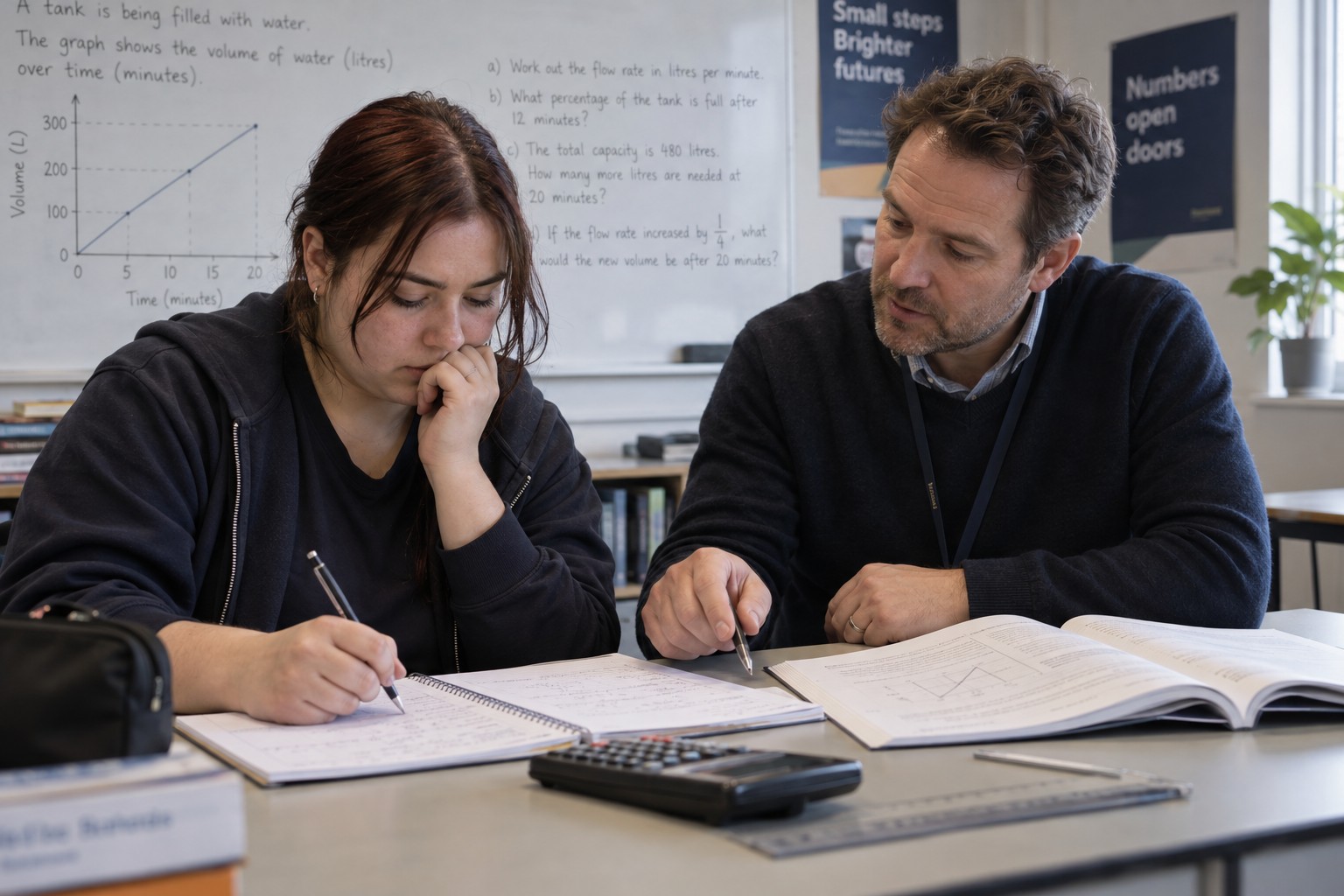
Responding to Maths Anxiety does not mean removing challenge, lowering expectations or interpreting every reluctant learner as anxious.
Some learners need more secure knowledge. Some need more practice. Some need explicit teaching, carefully sequenced examples or specialist support. Others may understand the Mathematics but lack confidence in applying it independently.
Psychological safety without purposeful challenge can limit learning. Challenge without psychological safety can prevent participation.
Effective practice holds both together.
Learners need to encounter difficulty without every mistake becoming evidence of inability. They need opportunities to explain their thinking, test an idea, recognise a misconception and try again. They also need sufficiently secure foundations to ensure that “productive struggle” does not become repeated confusion.
The objective is not to protect learners from Mathematics. It is to create the conditions in which they can participate in it.
What is the organisation hearing?
When a learner says, “I can’t do Maths,” the statement may describe their current confidence more accurately than their actual capability.
They may mean:
“I have failed before.”
“I don’t want other people to see me get it wrong.”
“I can follow the method, but I don’t know when to use it.”
“I can do this at work, but I don’t recognise it on a test.”
“I don’t yet trust myself to solve it without help.”
The response cannot rest entirely with the learner, and it cannot rest entirely with the Maths teacher.
We have spent years challenging the belief that some people simply cannot do Maths. We should be careful not to replace that belief with another: that because Maths is no longer mandatory in every programme, it is no longer necessary.
The stronger question is not whether every learner should follow an identical qualification route. It is whether every learner has a meaningful opportunity to develop the mathematical capability they need for work, life and future progression.
When fear of failure becomes a barrier to participation, does the organisation ask what is wrong with the learner – or what needs to change around them?
That answer tells us whether Maths is being treated as a compliance requirement, a specialist subject or a shared commitment to human capability.
If your organisation is reviewing how Maths, English and Digital Skills are positioned across curriculum, workforce capability and learner support, get in touch to discuss how Creating Excellence can help strengthen participation and capability.