

In this article, Christine explores why identifying future skills needs is no longer enough, and why providers, employers and leaders must build inclusive organisational capability if every learner is to participate, adapt and thrive in a rapidly changing world.
——————————————————–
We know more than ever about the skills our future economy will need.
The Skills England Annual Skills Report 2026, Sectoral Skills Needs Assessments, labour market intelligence, employer insight and Local Skills Improvement Plans are providing an increasingly detailed picture of where demand is heading.
The evidence is becoming stronger. The priorities are becoming clearer. Providers, employers and policymakers have access to more intelligence on which to base decisions than ever before.
So why do outcomes still differ so significantly?
If we understand the destination more clearly than ever before, why do some organisations adapt confidently while others continue to struggle with change?
Seeing the destination does not guarantee arrival
In a previous article, I explored why everything can begin to feel like a priority in further education. The issue was rarely the number of priorities themselves. More often, it was the absence of a coherent capability strategy that enabled organisations to connect those priorities and translate them into everyday practice.
That same pattern is becoming increasingly visible across the wider education and skills system.
Responding successfully to change is rarely about continually adding another initiative, framework or workstream. Organisations that respond well revisit what already exists, identify what needs to change and integrate new priorities into coherent ways of working.
They do not treat digital capability, inclusion, employability, employer engagement or curriculum development as separate additions competing for attention. They examine where these elements already exist and how they can be strengthened, connected and made more visible.
This is the same principle that underpins effective contextualisation. Maths, English and Digital Skills are most valuable when they are developed through meaningful vocational and occupational contexts, rather than bolted onto the side of a programme.
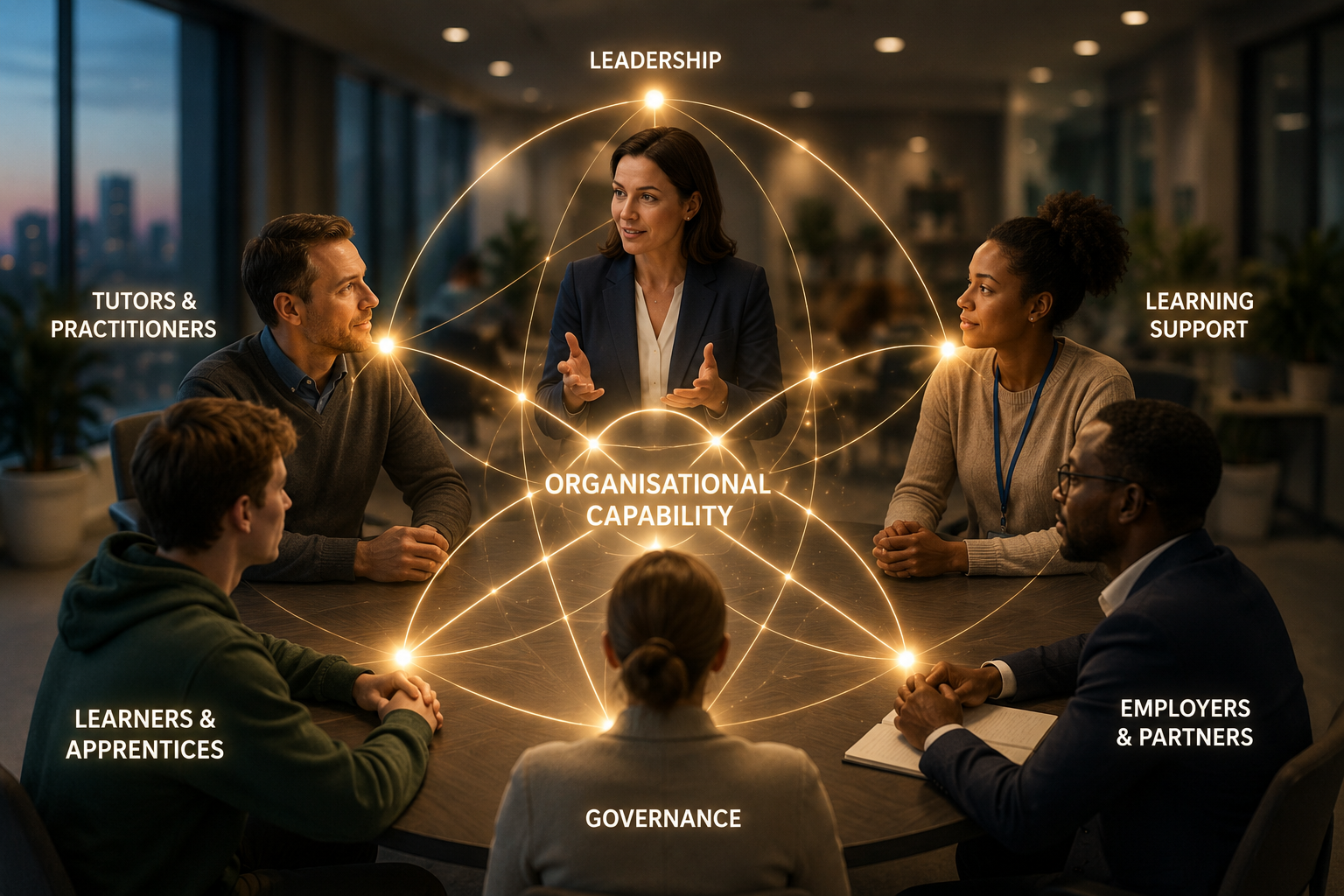
Organisational capability works in much the same way.
It is not something additional to deliver when there is time. It must be built naturally into leadership, curriculum, workforce development, employer relationships and the learner experience.
Strategies create direction. Capability determines whether people arrive there.
Understanding future workforce needs is only the beginning. Translating that understanding into consistently strong experiences and opportunities for learners, employers and communities is a very different challenge.
The gap between intelligence and implementation
Knowing what needs to change is not the same as being able to change.
Too often, the sector responds to a new challenge by introducing another qualification, framework, strategy or programme of professional development. Each may have value, but isolated activity does not automatically create capability.
A qualification may increase knowledge.
A CPD session may build awareness.
A strategy may establish intent.
But capability develops when leaders, curriculum teams, employers and frontline staff share a clear understanding of what they are trying to achieve and can translate that understanding into consistent decisions and practice.
This is why organisations with access to the same information can respond very differently.
Some interpret change confidently. They review their curriculum, work closely with employers, develop their workforce and create the conditions in which people can test, learn and improve.
Others become overwhelmed by competing demands, wait for greater certainty or reduce the challenge to a compliance exercise.
The difference is rarely the availability of information.
It is the capability to interpret evidence, make coherent decisions, respond to changing needs and sustain improvement when pressure increases.
As I explored in Why Is a Whole Organisation Approach Still So Difficult to Embed in FE?, improvement becomes fragile when responsibility sits with a small number of individuals rather than being understood and enacted across the organisation.
Capability is not what works only when the right people are available and conditions are favourable.
Capability is what continues to work when funding changes, staff move on, learner needs become more complex, employers are under pressure and digital expectations continue to evolve.

Inclusion exposes whether systems are truly capable
This is also why inclusion must sit at the centre of the future skills conversation.
Inclusion cannot be treated as an additional strand that follows once economic priorities, curriculum plans and delivery models have been agreed. It must shape how those decisions are made from the outset.
The renewed Ofsted further education and skills inspection arrangements reinforce the importance of understanding the quality and consistency of learners’ experiences. Inclusion is therefore not something organisations can place on the back burner until operational pressures ease.
It is part of how organisational quality and capability are judged.
If organisational capability depends on learners fitting the system, the system is not yet capable enough.
The strongest organisations do not design provision around the learners who find education, employment and change easiest to navigate. They create systems capable of responding to a diverse range of starting points, strengths and barriers.
That may include learners with SEND , learners experiencing SEMH needs, those with low confidence, young people whose previous experience of education has been negative, adults returning to learning, or people whose digital skills limit their ability to participate fully.
Designing inclusively does not mean lowering expectations.
It means creating the conditions that enable more learners to reach them.
The adjustments that remove barriers for some frequently improve clarity, accessibility, confidence and participation for everyone. This is why inclusive curriculum design is not a specialist consideration at the edge of provision. It is a central feature of strong curriculum and organisational design.
As explored in Why Does Curriculum Coherence Matter in FE and Why Must 2026 Be the Turning Point?, inclusion becomes more secure when it is anticipated through curriculum choices, teaching approaches and organisational systems rather than relying solely on reactive adjustments after a learner begins to struggle.
Inclusive capability is essential for some learners.
It is beneficial to all.
Employers need partners, not simply training providers
Capability is not created by providers alone.
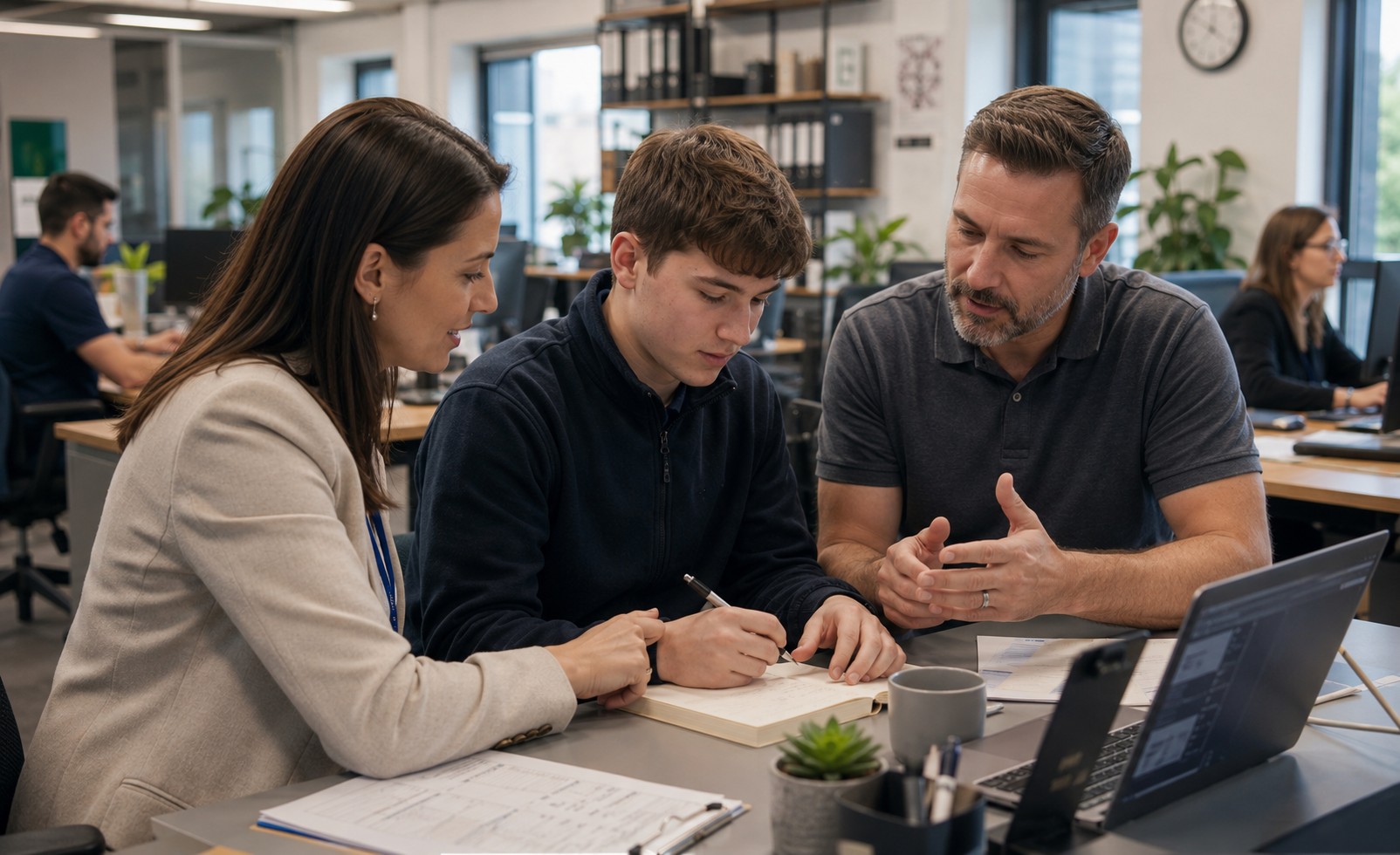
Employers are central to developing the skills, confidence and behaviours that learners will need, particularly within apprenticeships and work-based learning. Yet many employers have never been expected to think of themselves as learning organisations.
Large employers may have established learning and development teams, structured induction programmes and managers experienced in supporting apprentices. Many SMEs do not.
They may be experts in their industry, committed to their employees and keen to create opportunities, but unfamiliar with how to build psychological safety, structure learning, give developmental feedback, adapt support or respond to a young person who lacks workplace confidence.
The strongest providers do more than deliver a programme to an employer.
They help employers become effective learning environments.
That requires a more service-led relationship. It means helping employers understand not only what the apprenticeship or programme requires, but how workplace culture, communication, supervision and opportunity affect whether learning can be applied and sustained.
It also means helping employers see the wider return on their investment.
That investment may include levy funding, but it also includes managers’ time, workplace support, patience, feedback and a willingness to create space for development. The return is not simply programme completion. It is a more adaptable workforce, stronger internal capability and people who are increasingly able to contribute as roles and technologies change.
This is especially important where young people enter employment without the opportunities previous generations may have gained through Saturday jobs, sustained work experience or informal exposure to workplace expectations.
Employability cannot simply be presented as a list of behaviours that learners should already possess.
Providers and employers must create the experiences through which those capabilities can develop.
Preparing people for careers that will keep changing
Ultimately, this is about learners and the futures they are preparing to enter.
Every learner beginning a programme today is preparing for a career that is likely to evolve repeatedly throughout their working life.
Technologies will continue to develop. Industries will change. Some roles will disappear, others will emerge, and many will be reshaped in ways that cannot yet be predicted precisely.
Technical and occupational knowledge will remain essential, but it will not be sufficient on its own.
Learners will also need communication, collaboration, problem-solving, planning, critical thinking, digital capability, adaptability and the confidence to continue learning. Artificial intelligence is part of this changing environment, but it sits within a much broader requirement for people to participate safely, critically and confidently in an increasingly digital world.
The NFER research into the essential employment skills needed by 2035 reinforces the importance of developing these capabilities deliberately rather than assuming they will emerge automatically.
They are not peripheral “soft skills”, and they are not simply another checklist to complete during a programme.
They influence whether people can transfer learning into new situations, respond constructively when expectations change and continue developing throughout their careers.
For learners who already face barriers to participation, the consequences are particularly significant.
Without digital confidence, communication skills, workplace experience or the resilience to respond to unfamiliar situations, change can quickly become something to fear rather than navigate. A difficult transition, an unsupportive workplace or an inaccessible learning experience can reinforce the belief that new challenges are simply not for them.
By contrast, well-designed learning and workplace experiences can establish a very different pattern.
They can show learners that skills can be developed, uncertainty can be managed, support can be accessed and change does not have to mean failure.
That is why this is about more than preparing people for their first job.
It is about developing the capability to keep learning, adapting and progressing long after the programme has ended.
Excellence must be designed for the future
The sector now has stronger evidence about future skills demand and clearer mechanisms for connecting national priorities, local needs and employer insight.
But information alone will not create the outcomes we need.
The next challenge is whether providers, employers and leaders can build organisations that are coherent enough to translate evidence into action, inclusive enough to enable every learner to participate and adaptable enough to keep responding as circumstances change.
The future will not be shaped simply by those who predict change most accurately.
It will be shaped by those who build the capability to respond to it – inclusively, consistently and with confidence.
Because excellence is not something organisations add on.
It is something they design for.
Creating Excellence works with post-16 providers and partners to strengthen the organisational conditions that enable learners, staff and employers to thrive and grow. This includes developing inclusive curriculum and practice, whole-organisation approaches, workforce confidence and stronger connections between strategy and everyday delivery.
If your organisation is thinking differently about future skills, inclusion and workforce capability, I’d be delighted to explore how Creating Excellence can help build capability that lasts.