
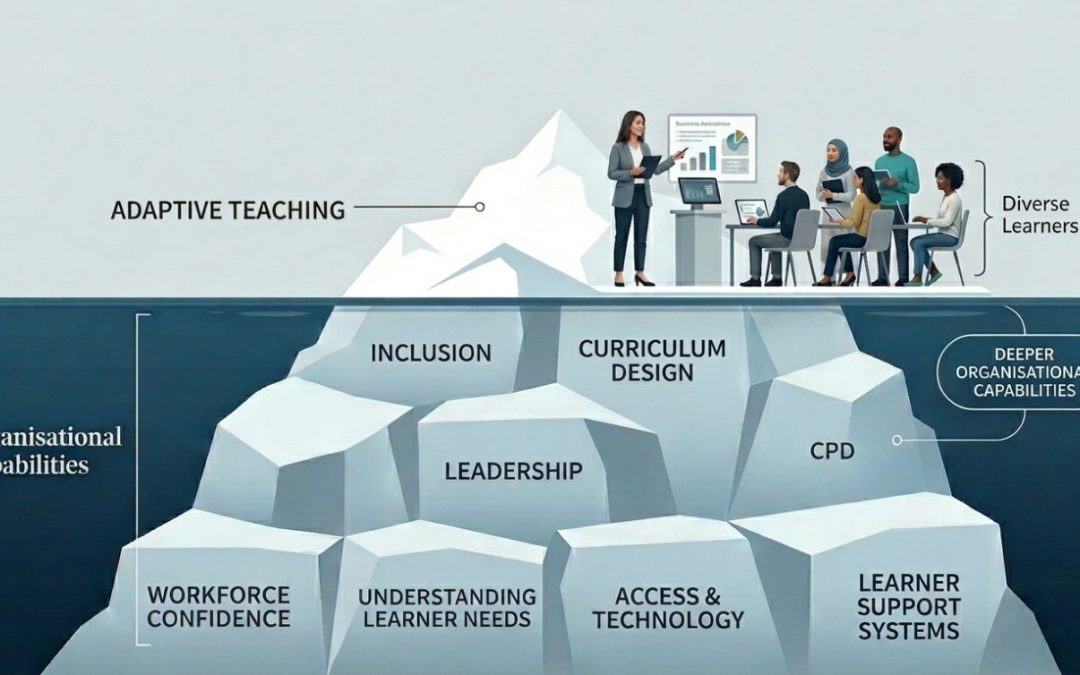
Adaptive teaching has become one of the most frequently discussed concepts in education.
It appears in CPD programmes, quality improvement plans, inspection conversations and curriculum reviews. Staff are encouraged to adapt resources, vary approaches, scaffold learning and respond to individual learner needs.
Few would argue against its importance.
Yet despite significant investment in training and development, many organisations continue to struggle to embed adaptive teaching consistently across provision.
This raises an important question.
If adaptive teaching is now widely understood, why does it so often become inconsistent when organisations face pressure?
Perhaps the answer is that adaptive teaching is not primarily a teaching strategy at all.
Perhaps it is one of the clearest indicators of organisational capability.
In this article, Christine explores why adaptive teaching often succeeds in isolated pockets but struggles to become embedded across organisations, and why inclusion, participation, progression and learner success increasingly depend upon treating adaptive teaching as a whole-system capability rather than an individual teaching technique.
Adaptive Teaching Is Often Treated as a Classroom Strategy
Most discussions about adaptive teaching focus on what happens inside the classroom.
Teachers are encouraged to adjust explanations, vary questioning, provide scaffolding, use different resources and respond to learner needs as they emerge.
These are undoubtedly important practices.
However, viewing adaptive teaching primarily as a classroom strategy can unintentionally create a problem.
It places responsibility almost entirely on individual practitioners.
The assumption becomes that adaptive teaching is something teachers simply choose to do.
In reality, adaptation depends upon a range of conditions being present.
Staff need meaningful information about learners.
They need:
– confidence in recognising barriers to learning.
– curriculum structures that allow flexibility.
– access to appropriate tools and resources.
– professional development that develops judgement as well as knowledge.
Without these foundations, adaptive teaching becomes heavily dependent on individual expertise, experience and goodwill.
When strong practitioners leave, consistency often leaves with them.
The Problem Is Not Usually the Teacher
When adaptive teaching becomes inconsistent, it is tempting to focus on individual practice.
However, the underlying issue is often organisational rather than personal.
The most common barriers rarely involve a lack of commitment from staff.
Instead, organisations may be grappling with fragmented learner information, inconsistent processes, curriculum constraints, competing priorities or varying levels of workforce confidence.
These challenges become particularly visible when organisations experience pressure.
– Staff turnover increases.
– Learner needs become more complex.
– Funding changes.
– Curriculum reforms arrive.
– Technology evolves.
– Inspection expectations shift.
At precisely the point where adaptive teaching becomes most important, it often becomes harder to sustain.
This is because adaptive teaching is not simply a collection of classroom techniques.
It is the visible outcome of multiple organisational capabilities working together effectively.
Why Adaptive Teaching Depends on Organisational Capability
One of the strongest themes emerging across further education is that quality increasingly depends on capability rather than compliance.
The organisations most likely to thrive are not necessarily those with the most policies, initiatives or interventions.
They are the organisations that consistently create the conditions for effective practice.
Adaptive teaching provides a useful example.
– If learner information is difficult to access, adaptation becomes harder.
– If staff confidence is low, adaptation becomes inconsistent.
– If curriculum design is rigid, adaptation becomes limited.
– If support systems are unclear, adaptation becomes reactive rather than proactive.
The question is no longer whether staff understand adaptive teaching.
The more important question is whether the organisation enables adaptive teaching to happen consistently.
This links directly to the wider challenge facing many providers today.
When systems tighten, quality does not improve by default. It depends on what is already strong.
Adaptive teaching is often one of the first places where underlying strengths and weaknesses become visible.

What Adaptive Teaching Reveals About Inclusion in Further Education
This matters because adaptive teaching sits at the heart of inclusion.
Too often inclusion is viewed as a specialist function, a SEND responsibility or a collection of reasonable adjustments.
Yet recent inspection thinking, policy developments and sector discussions increasingly point towards a different interpretation.
Inclusion is becoming a measure of organisational capability.
– Can barriers be identified early?
– Can staff respond confidently?
– Can curriculum design support participation?
– Can learners access learning in ways that allow them to succeed?
Adaptive teaching is one of the clearest ways these questions become visible in practice.
When adaptive teaching works well, learners experience fewer barriers.
– They participate more confidently.
– They develop greater independence.
– They remain engaged for longer.
– They are more likely to progress successfully.
Inclusion becomes something learners experience rather than something organisations describe.
This aligns closely with the argument explored in my article on the whole organisation approach, where sustainable improvement depends upon multiple parts of the organisation working together rather than relying on isolated interventions.
The Link Between Adaptive Teaching, Participation and Progression
One of the recurring themes across recent policy reviews, careers education developments and inspection discussions is participation.
Whether we are discussing CEIAG, SEND, apprenticeships, English and Maths, Digital ability, learner transitions or employability, the same question keeps appearing:
Can learners access, participate in and benefit from the opportunities available to them?
Adaptive teaching matters because it sits at the point where policy ambitions become learner experience.
– A learner who cannot access learning consistently is less likely to develop confidence.
– A learner with low confidence is less likely to participate fully.
– Reduced participation often limits progression opportunities.
What appears to be a classroom issue can quickly become a progression issue.
Adaptive teaching therefore connects directly to learner destinations, employability, belonging and social mobility.
It is not simply about helping learners cope with learning.
It is about helping learners access opportunity.
This reflects themes explored in my article on participation and progression pathways, where access to opportunity depends upon more than qualifications alone.

Can Technology Reduce Barriers Without Creating Dependency?
This is also why discussions about AI and technology require careful framing.
Many conversations focus on the tools themselves.
Yet some of the most valuable developments are surprisingly simple.
– Immersive Reader.
– Speech-to-text.
– Translation tools.
– Multimodal content.
– Accessibility features.
These tools matter not because they are revolutionary, but because they reduce friction.
– They help learners access learning more independently.
– They allow barriers to be addressed earlier.
– They create additional pathways into participation.
Importantly, they shift support away from special arrangements and towards universal accessibility.
This is where technology aligns most strongly with adaptive teaching.
Not as a replacement for professional judgement.
Not as a shortcut.
But as a mechanism for increasing access, reducing barriers and strengthening learner independence.
The real question is not whether organisations are using AI.
The more important question is whether they are using available tools to make learning more accessible.
What Ofsted Is Really Seeing When It Looks at Adaptive Teaching
Although inspection conversations may focus on teaching, learning and learner experience, adaptive teaching often provides insight into much wider organisational issues.
Inspectors are increasingly interested in whether learners can access learning successfully, make progress and achieve positive outcomes.
Adaptive teaching contributes directly to these experiences.
However, it also reveals something deeper.
It reveals whether:
– staff understand learner needs.
– information flows effectively.
– curriculum decisions are supporting inclusion.
– professional development is translating into practice.
– leaders have created the conditions for consistency.
In many ways, adaptive teaching acts as a window into organisational capability.
It demonstrates whether inclusion is operational or merely aspirational.
Adaptive Teaching Is Not a Teaching Strategy – It’s a System Capability
Perhaps the most important shift is recognising what adaptive teaching actually reveals.
When adaptive teaching works consistently, it often indicates that curriculum design, leadership, inclusion, workforce development and learner support are working together effectively.
When it struggles, the issue may not lie with teaching at all.
It may be exposing deeper capability gaps within the organisation.
This matters because further education is operating in an environment of increasing complexity.
– Learner needs are changing.
– Technology continues to evolve.
– Expectations around inclusion continue to grow.
– Workforce pressures remain significant.
The organisations most likely to succeed will not necessarily be those with the most initiatives.
They will be those that build the organisational capability to respond consistently when conditions change.
Adaptive teaching is one of the clearest indicators of whether that capability exists.
Because ultimately, adaptive teaching is not a teaching strategy.
It is evidence of a system that is capable of helping learners participate, progress and thrive.

How Creating Excellence Can Help
Adaptive teaching is often discussed as a teaching issue. Increasingly, I believe it is a capability issue.
If adaptive practice depends on individual staff working harder, consistency will always remain fragile. Sustainable improvement comes from building the systems, confidence and conditions that make adaptive teaching possible across an organisation.
Through consultancy, diagnostics, CPD and strategic support, Creating Excellence helps providers strengthen the organisational capabilities that sit behind inclusion, participation and learner success.
If you are exploring how adaptive teaching, SEND, curriculum design, workforce confidence or learner participation fit within your wider quality and improvement priorities, I would be delighted to start a conversation.