

Why practical AI depends on evidence, professional judgement and valid assessment
In this article, Christine Edwards QTLS explores why practical AI depends on the quality of professional thinking around the tool. She considers what purposeful personalisation looks like, why polished outputs are not automatically valid evidence of learning and how providers can move from experimentation to organisational capability.
An educator asks an AI tool to create three versions of an activity for three different learners. Within seconds, the tool produces simplified instructions, an extension task and an alternative explanation. On the surface it looks like personalisation. It may even save time.
But the speed of the response can conceal the harder question: what made those versions right for those learners?
If the process began with a broad label, a test score or an assumption about ability, AI may simply turn a weak interpretation into polished material.
If the educator began with clear educational purpose, usable evidence, learner voice and sound professional judgement, AI may help them explore possibilities they would not otherwise have had time to create.
The difference is not the sophistication of the tool. It is the quality of the thinking around it.
Personalisation is a decision, not a product
AI is often presented as a route to personalised learning. That promise is attractive in post-16 education, where staff are supporting learners with different starting points, aspirations, confidence, prior experiences and support needs, often under significant time pressure.
Yet personalisation is easily reduced to producing more versions of the same content. A shorter worksheet; material at a different reading level; or an additional stretch activity – may all be useful, but variation does not automatically result in personalisation.
The stronger question is whether the response helps this learner participate, think, practise, receive feedback and make progress towards a meaningful goal.
That aspect of the learning process requires professional interpretation. Initial and diagnostic assessment, skills scans, learner conversations, previous evidence and aspirations all must become usable understanding, not static paperwork.
Staff need to notice patterns, identify what is not yet known and distinguish a barrier to learning from a gap in knowledge, confidence, language, access or prior opportunity.
AI can help connect evidence, generate alternative explanations, suggest questions and pressure-test a plan. But it cannot decide what matters most for a learner, because that judgement depends on context, relationships, subject expertise and ethical responsibility.
That is especially important when AI is used to adapt learning. A faster adaptation is not automatically a better educational decision. The test is whether it reduces barriers and increases participation and independence while preserving challenge, ambition and access to the full curriculum.
AI should provoke professional thinking, not replace it
A useful way to position AI is as a collaborator within a professional reasoning process.
It can accelerate the generation of possibilities, but its outputs should be treated as provocations, not prescriptions.
An educator might use AI to ask:
– What are several plausible explanations for this pattern in a learner’s work?
– How could the same concept be represented visually, verbally and through workplace practice?
– What assumptions are built into this activity?
– Where might the language, format or context exclude someone?
– What evidence would show genuine understanding rather than successful completion?
Used in this way, AI does more than create content. It makes professional reasoning more visible. It can widen the options considered and create space for curiosity. But the educator remains responsible for checking accuracy, accessibility, bias, relevance and likely consequence.
This matters because AI can, and will, amplify whatever sits beneath it.
Strong curriculum thinking can become more responsive and more efficient.
Weak purpose, fragmented evidence or lowered expectations can also be reproduced at speed.
AI will not fix capability gaps. It exposes them.
Assessment is the pressure test
The strongest test of AI-supported personalisation may be assessment.
If AI helps a learner produce a more polished final answer, that does not necessarily tell us what the learner understands, can apply independently or can explain and defend.
Output and evidence are not the same thing. The output is what the learner submits or performs. Evidence is what that output, together with the process behind it, allows an educator or assessor to conclude about the learner’s knowledge, understanding, skill and judgement.
A strong AI-assisted product may contribute useful evidence, but it is not automatically valid or sufficient evidence of learning. The more convincing the product becomes, the more carefully we may need to examine the process and the learner’s judgement: what decisions did they make, what did they accept or reject, and what can they explain and defend?
Jen Deakin’s work on Assessment in the age of AI offers an important direction:
– validity before surveillance;
– transparency before suspicion;
– design before detection;
– and education before enforcement.
The challenge is not simply to prevent inappropriate use. It is to design learning and assessment so that learner reasoning becomes visible and the evidence collected still supports a valid judgement.
That may mean paying more attention to process: discussion, questioning, drafts, decision points, performance, reflection and the learner’s explanation of how and why AI was used.
It may mean being explicit about when AI is appropriate, what must be checked, how its use should be declared and which parts of a task must demonstrate independent knowledge or performance.
This is not a case for removing AI from learning. Learners will need to use it critically and responsibly in education, work and wider life.
Nor is it a case for treating every use as evidence of misconduct.
It is about ensuring that, where AI has helped to produce a more polished final product, it does not obscure what the learner actually knows, understands and can do.
The practical questions are therefore not only, “Did AI improve the output?” but also, “Did it strengthen the learner’s understanding, participation, judgement and capability? What evidence shows that it did?”

The emerging divide is a capability divide
Access to AI will remain uneven, but access alone is not the only dividing line.
A deeper divide is emerging between people and organisations able to use AI with purpose and judgement, and those expected to experiment without the confidence, guidance or conditions to do so well.
The World Economic Forum’s Future of Jobs Report 2025 reinforces that technological literacy will grow in importance alongside analytical thinking, creative thinking, resilience, curiosity and lifelong learning. The implication is not that human capability becomes less important. It is that technical and human capability must develop together.
The same is true for staff development.
A generic prompting session may create initial confidence, but it does not establish professional AI capability.
Staff need supported opportunities to apply AI to real educational problems, compare outputs, discuss ethical and inclusion implications, examine assessment validity and review impact on learners.
Leadership confidence is not evidence that the workforce feels ready.
Tool availability is not implementation.
Investment is not impact.
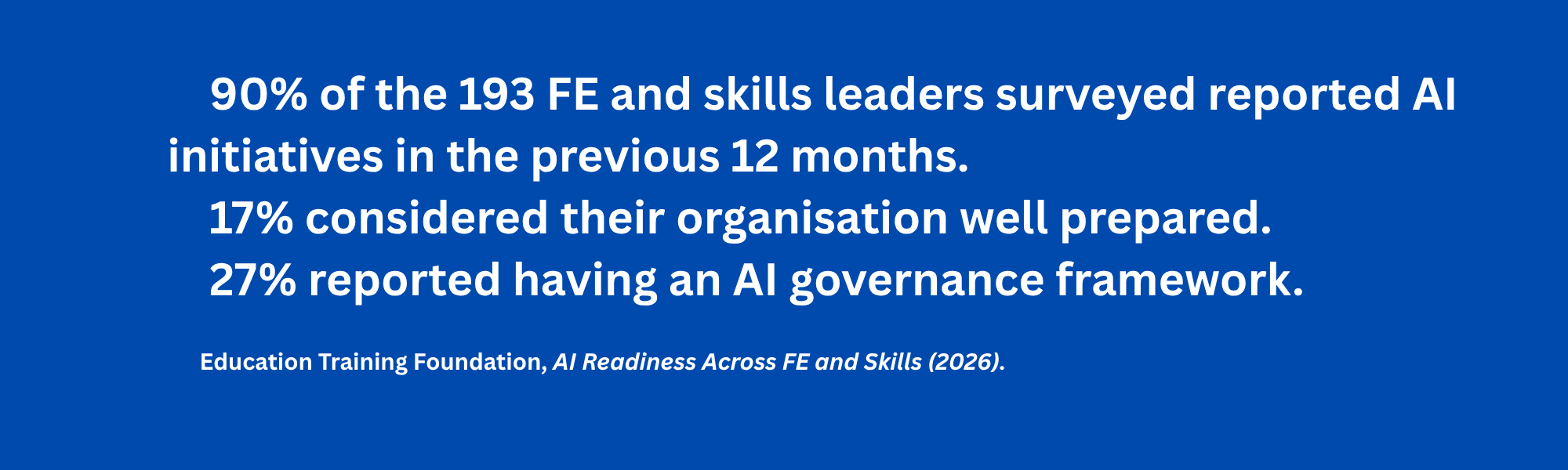
That distinction matters because adoption is already outpacing readiness. Recent research from the Education Training Foundation found that 90% of the 193 FE and skills leaders surveyed reported AI initiatives in the previous 12 months, yet only 17% considered their organisation well prepared and just 27% reported having an AI governance framework. The gap is not one of interest or experimentation. It is the leadership, professional capability and organisational confidence needed to turn experimentation into responsible, educationally worthwhile practice.
A reflective sequence for practical AI
If providers want AI to improve learning, implementation needs a disciplined rhythm. One possible reflective sequence is:
1. Purpose: What educational problem are we trying to solve, and why does it matter for the learner?
2. Evidence: What do we know, how reliable is it, and what does the learner say?
3. Interpretation: What might explain the current position, and what are we assuming?
4. Possibilities: How could AI help generate, compare or adapt possible responses?
5. Pressure test: What might the tool have missed? Is the response accurate, accessible, ethical and educationally sound?
6. Action: What will the educator and learner actually do differently?
7. Review: What evidence will show whether participation, confidence, understanding or performance improved?
This reflective sequence is not a rigid model, and it should not create another layer of paperwork. Its purpose is to keep educational reasoning in control of the technology.
The prompt comes after purpose, evidence and interpretation – not before them.
Organisational readiness sits beneath individual practice
Even strong practitioners cannot carry responsible AI adoption alone. Their judgement needs organisational conditions that make relevant information usable and responsibilities clear.
Data quality, privacy, safeguarding, accessibility, governance, auditability and assessment expectations all matter. So do time, professional trust and permission to test, challenge and sometimes reject an AI-generated response.
The Department for Education’s guidance on generative AI in education is clear that safety, data protection and professional responsibility remain human responsibilities.
UNESCO’s human-centred guidance similarly places agency, inclusion and critical thinking at the centre. These are not separate compliance considerations to add after experimentation. They shape what responsible practice is from the start.
Providers therefore need more than an approved-tools list. They need a shared account of what good AI-supported learning looks like; how staff and learners will develop critical AI literacy; how assessment evidence will remain valid; and how impact will be reviewed. That is still an emerging capability: in the ETF study, 68% of leaders reported that their organisation had not yet taught AI literacy to learners.
The next stage of AI readiness is not asking whether staff are using it. It is asking whether the organisation can explain what difference that use is making, for whom, under what conditions and with what evidence.
Experimentation may be the beginning of AI adoption. Evaluation is what turns it into organisational learning.

The response can be generated. The professional thinking cannot be outsourced.
AI can extend reach, accelerate design and help educators consider more possibilities.
It may support more responsive explanations, better questions and richer routes into learning.
But it does not remove the need for professional expertise. It raises the value of that expertise.
The organisations that benefit most will not necessarily be those that adopt the greatest number of tools. They will be those that can connect technology with educational purpose, usable evidence, inclusive design, valid assessment and accountable human judgement.
Before asking staff to produce more with AI, leaders might ask:
– What problem are we actually trying to solve?
– What evidence about learners is informing our use of AI?
– Are AI-supported activities making learner thinking more visible or merely making outputs more polished?
– Where might accessibility, confidence, bias or unequal access change the experience?
– How are staff being supported to question, adapt and reject outputs?
– What would still represent good teaching if the technology were removed?
– How will we know whether the approach improved participation, confidence or learning?
Professional AI-supported practice must also give learners an active role. Critical AI literacy develops when learners are expected to question outputs, test claims, identify bias or omission, reject unsuitable suggestions and explain the choices they make. This does not remove professional responsibility; it creates the conditions in which learners can develop and exercise judgement for themselves.
Practical AI is not defined by how quickly a tool responds. It is defined by the quality of the professional decisions that follow.
Creating Excellence supports post-16 providers and employers to strengthen professional practice, AI readiness and the organisational capability that turns experimentation into better learning. If your organisation is exploring how to move from AI activity to purposeful, evidence-led practice, get in touch to explore how a focused review or professional development programme could help.