

Every so often, an article emerges that captures the thinking behind everything else.
Over the past year, I’ve written about adaptive teaching, AI readiness, participation, CEIAG, inclusion, workforce development and organisational improvement. Although the topics appeared different, they all kept leading me back to the same question.
Why does every new priority seem to become another separate initiative?
The more I reflected on conversations with providers, leaders and practitioners, the clearer it became that the challenge is rarely the number of priorities. It’s how we connect them.
This article explores why organisational capability sits underneath them all, and why strengthening that capability may be one of the most important investments any Further Education provider can make.
Christine Edwards QTLS
AI. Inclusion. Adaptive teaching. Curriculum reform. CEIAG. Apprenticeships. V Levels. T Levels. Maths. English. Digital Skills. Attendance. Participation and Engagement. Progression. Safeguarding. SEND/SEMH. NEET/ Young People. Staff wellbeing. Employer Engagement.
In Further Education and Skills, every week can feel as though another priority has landed.
Each one matters. Each one has a rationale. Each one connects to learner experience, progression, quality, accountability or workforce confidence. The problem is not that these priorities are unimportant. The problem is that they are often experienced as separate demands.
A new policy becomes a new action plan.
A new framework becomes a new briefing.
A new risk becomes a new training session.
A new expectation becomes another plate to spin.
Before long, even strong organisations can begin to feel fragmented. Leaders are working hard. Managers are working hard. Practitioners are working hard. Yet the overall experience can still feel overwhelming, because every initiative appears to require its own response.
But what if these are not separate priorities?
What if AI, inclusion, adaptive teaching, CEIAG, participation, employer engagement, professional development and quality improvement are all pointing towards the same underlying issue?
That issue is organisational capability.
Why Does Everything Feel Like a Priority?
Further Education does not operate in a calm or simple environment. Providers are responding to reform, funding pressures, changing learner needs, workforce challenges, technological change, employer expectations and regulatory scrutiny. At the same time, they are serving learners and apprentices whose barriers, ambitions and support needs are becoming increasingly complex.
It is hardly surprising that priorities multiply.
One conversation focuses on AI readiness. Another focuses on SEND/ SEMH and inclusion. Another turns to attendance, progression or apprenticeships. Another asks whether staff have the confidence to adapt teaching, contextualise learning or support learners with English, Maths and Digital Skills. Oh… and while you’re at it, don’t forget careers guidance. Each conversation is valid.
This mirrors a theme I explored in What Does AI Readiness Actually Look Like in Further Education? Technology is rarely the challenge on its own; it is how organisations build the capability to use it confidently and consistently that determines success.
The danger comes when each conversation is treated as separate.
When that happens, organisations can end up building parallel improvement activity. Separate strategies. Separate meetings. Separate CPD sessions. Separate reporting processes. Separate evidence trails. Separate language.
On paper, this can look thorough.
In practice, it can feel exhausting.
The result is not always poor practice. Often, it is the opposite. There may be committed staff, thoughtful leaders and genuine improvement work taking place. But because the work is not sufficiently connected, people experience it as accumulation rather than alignment.
That is when improvement starts to feel like pressure.
Why Good Organisations Still Feel Overwhelmed
One of the most damaging assumptions in education is that overwhelm is a sign of weak leadership or poor commitment. In reality, many organisations feel overwhelmed precisely because they care about doing things properly.
They want to:
– respond to new expectations.
– support learners well.
– prepare apprentices for work.
– build staff confidence.
– meet external requirements.
They want to improve.
The issue is not intention.
The issue is translation.
Can the organisation consistently translate strategic intent into everyday practice?
That question matters because intent alone does not change learner experience. Policies do not teach. Strategies do not adapt learning in real time. CPD logs do not build professional confidence by themselves. Improvement plans do not automatically create better conversations between tutors, managers, learners and employers.
The gap between what an organisation intends and what people experience day to day is where capability either strengthens or breaks down.
This is why the old language of intent, implementation and impact still matters, even when the terminology changes. Those three ideas have not disappeared. They have simply become embedded in different conversations.
Leaders may no longer be asked to describe them in the same explicit way, but the underlying questions remain.
What are you trying to achieve?
How is this being understood and enacted across the organisation?
What difference is it making to learners, apprentices, staff and employers?
The organisations that answer those questions well are not necessarily the ones with the most initiatives. They are the ones where people understand how the work connects.
That is the difference between activity and capability.
Transactional Improvement or Capability Building?
Professional development provides a useful example.
Most organisations recognise the importance of CPD. Staff complete mandatory training, attend development sessions and engage with new guidance as it emerges. Yet even the best professional development can become transactional if it is disconnected from the wider purpose of the organisation.
Staff attend because they should.
Certificates are recorded.
Compliance is demonstrated.
The activity has taken place.
But has capability actually increased?
This challenge extends far beyond professional development.
– Artificial intelligence can become another training session.
– Adaptive teaching can become another observation focus.
– Inclusion can become another action plan.
– Careers guidance can become another framework.
– Employer engagement can become another set of meetings.
– Quality improvement can become another document.
None of these initiatives are the problem.
The problem is when they remain isolated from one another.
As discussed in Why Does Adaptive Teaching Break Down Under Pressure in Further Education?, sustainable improvement comes from developing professional confidence and judgement rather than treating adaptive practice as another compliance exercise.
When every improvement priority develops its own language, its own processes and its own expectations, practitioners are left trying to navigate multiple parallel conversations. They become experts at responding to individual initiatives but are given fewer opportunities to understand how those initiatives fit together.
That is where confidence begins to erode.
Professionals rarely become overwhelmed because they care too little.
They become overwhelmed because they care enough to try to do everything well.
Without a coherent organisational strategy that connects those expectations, improvement starts to feel like an ever-growing list rather than a meaningful journey.
Capability-building takes a different approach.
Instead of asking,
“How do we implement another initiative?”
it asks,
“What knowledge, confidence and shared understanding do our people need to respond well to any initiative?”
That is a fundamentally different conversation.
One focuses on activity.
The other focuses on people.
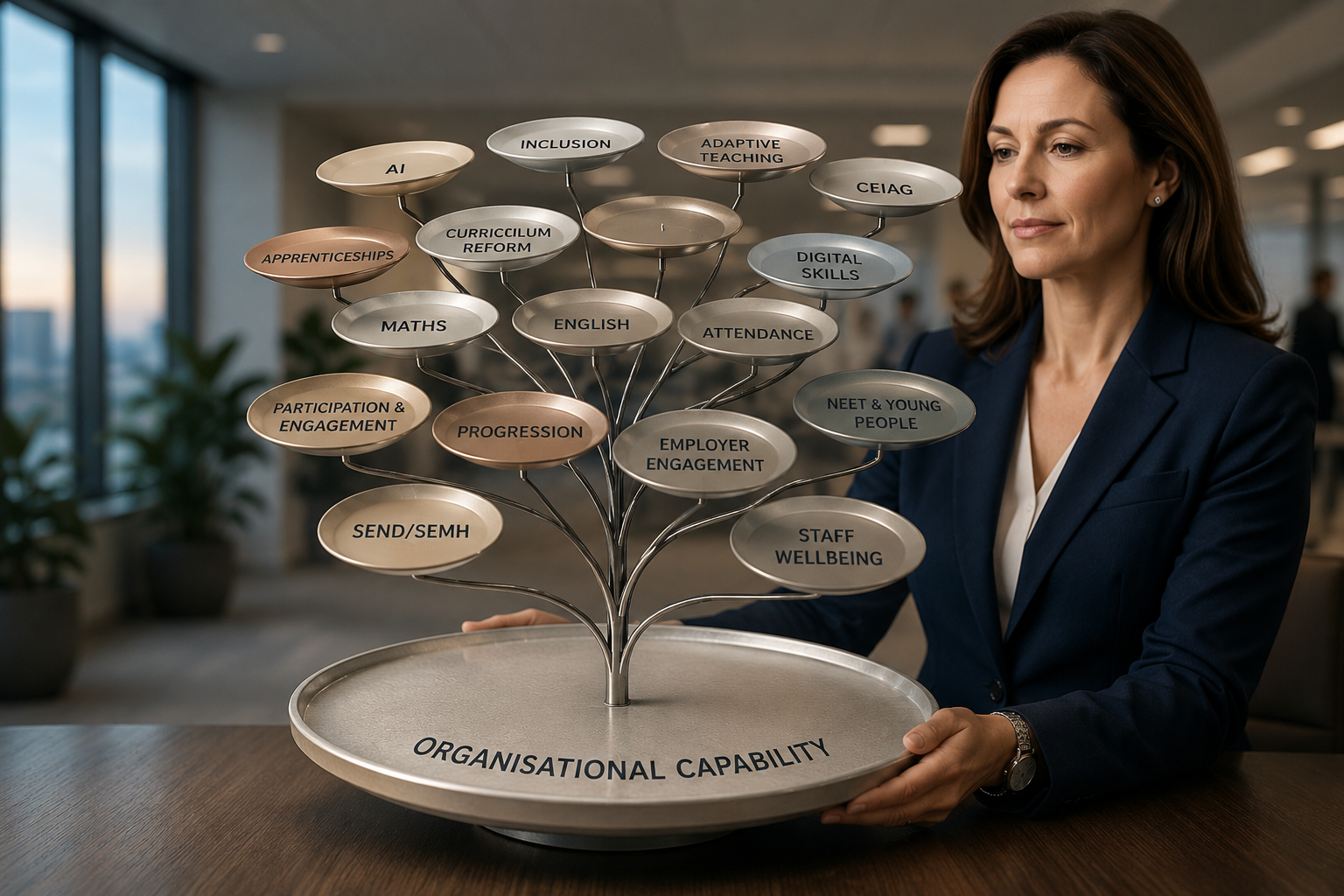
The Bigger Plate
During a recent discussion, someone described Further Education as feeling like a constant juggling act.
The image was instantly recognisable.
Every new priority can feel like another spinning plate.
– Artificial intelligence.
– SEND/SEMH.
– Adaptive teaching.
– Maths and English.
– Digital Skills.
– Employer Engagement.
– Attendance.
– Engagement.
– Progression.
– CEIAG.
– Curriculum reform.
– Professional development.
– Wellbeing.
– Quality assurance.
The natural instinct is to become better at spinning more plates.
But perhaps that is the wrong challenge.
Perhaps organisations do not need people to become experts at managing an ever-increasing number of separate priorities.
Perhaps they need something bigger underneath them all.
Imagine replacing twelve spinning plates with one larger, more stable platform.
That platform is organisational capability.
When people:
understand the organisation’s purpose…
they understand how different priorities connect…
they have the confidence to exercise professional judgement…
leaders consistently reinforce shared expectations…
professional development builds thinking rather than simply transferring information…
Then the individual initiatives become easier to manage because they are no longer competing for attention.
They become different expressions of the same organisational purpose.
This is where capability becomes much more than competence.
Competence is knowing what to do.
Capability is being able to apply professional judgement confidently in changing circumstances.
That distinction matters because Further Education is increasingly characterised by complexity rather than certainty.
No framework can anticipate every learner.
No policy can predict every classroom conversation.
No strategy can prescribe every decision that practitioners will make.
The organisations that thrive are therefore not those with the longest list of initiatives.
They are the organisations that develop people who can make consistently good decisions because they understand the principles that sit underneath them.
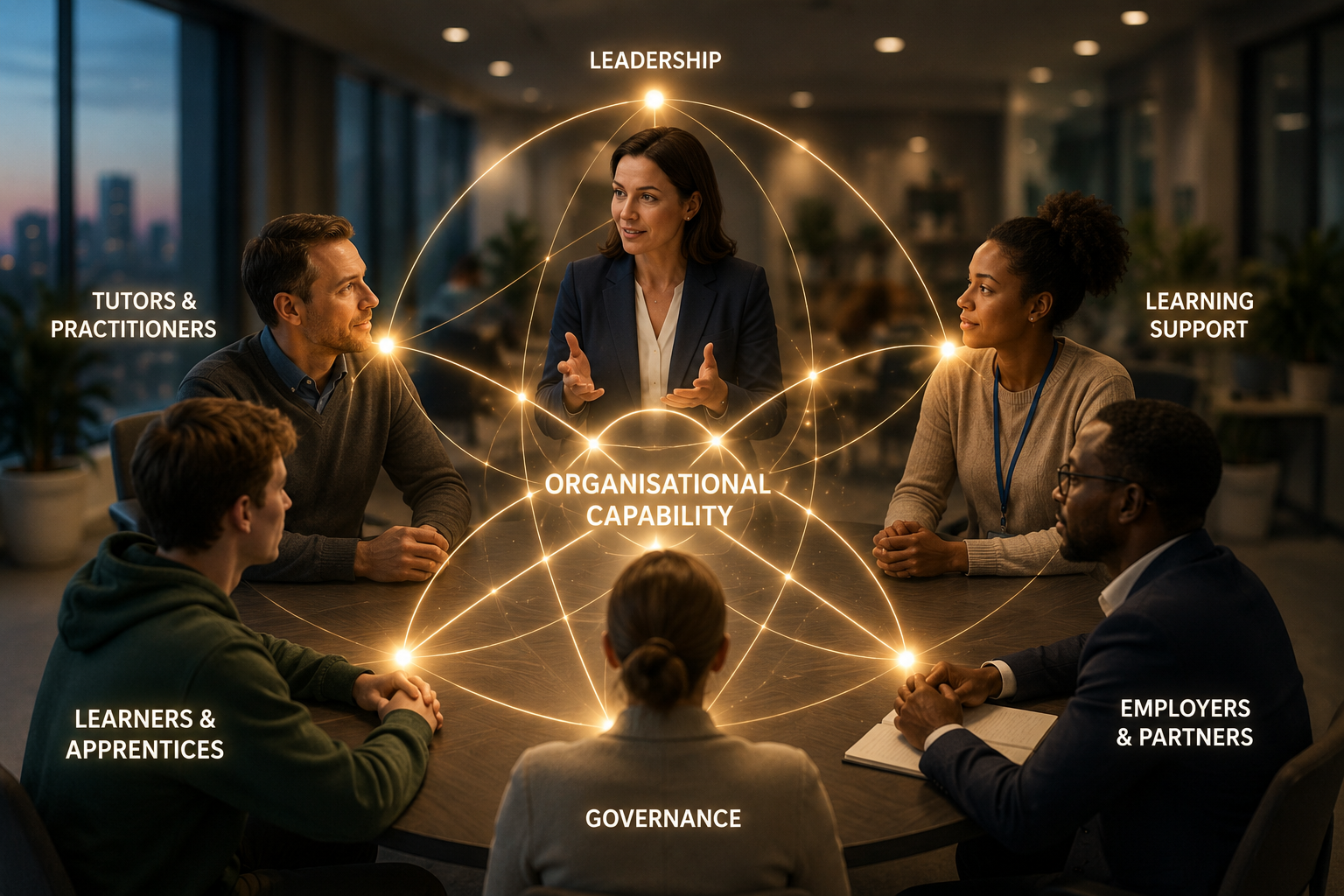
What Organisational Capability Actually Looks Like
Organisational capability is often mistaken for having the right policies, the right structures or the right documentation.
Those things matter.
But they are not capability.
Capability becomes visible in everyday conversations.
It is…
reflected in the way a curriculum manager explains organisational priorities.
heard in the confidence with which a tutor adapts learning for a learner who needs a different approach.
demonstrated when employer engagement teams, learning support practitioners and teaching staff describe the same organisational purpose using different words but the same underlying principles.
evident when governors challenge leaders on strategic priorities that are clearly understood throughout the organisation, rather than existing only within board papers.
Across recent leadership publications, inspection findings and sector discussions, the same themes continue to emerge.
Shared purpose.
Strategic ownership.
Collaboration.
Systems thinking.
Belonging.
Professional learning.
Collective responsibility.
Although the language varies, the underlying message is remarkably consistent.
Strong organisations create environments where people understand not only what they are doing, but why they are doing it and how their work contributes to the wider mission.
That understanding changes everything.
People stop responding to initiatives in isolation.
Instead, they begin making decisions through a shared organisational lens.
That is when consistency becomes a natural outcome rather than something that has to be monitored into existence.
Capability Creates Coherence
One of the most encouraging developments across the Further Education and skills sector is that many of today’s leadership conversations are beginning to move in the same direction.
Whether the discussion focuses on inclusion, systems leadership, professional development, collaboration, governance or workforce development, the underlying themes are remarkably similar.
Shared purpose.
Collective responsibility.
Professional judgement.
Strategic ownership.
Connected thinking.
These are not separate leadership theories.
They are different expressions of organisational capability.
The same principle underpins careers education. In Beyond Careers Advice: CEIAG as the Infrastructure of Inclusion, I argued that effective careers guidance succeeds when it becomes embedded within organisational thinking rather than operating as a standalone function. Like the other themes explored in this article, its success depends less on isolated activity and more on the organisational capability that connects it to the wider learner experience.
The same pattern is visible across recent inspection reports. Organisations that are recognised for their strengths are rarely described simply as having the “right” policies or the “right” processes. Instead, there is a consistent emphasis on leaders understanding their provision; staff working together effectively; professional development strengthening practice; governors providing informed challenge; and learners experiencing a coherent curriculum supported by consistent expectations. Where improvement is needed, the challenges are often less about a lack of commitment and more about inconsistency, fragmentation or gaps between intention and everyday practice.
That distinction matters.
Inspection does not create organisational capability. It simply makes it visible.
Leadership presentations do not create organisational capability.
Professional development does not create organisational capability.
They reveal it.
They strengthen it.
They support it.
But the coherence itself comes from something deeper: people sharing enough understanding, confidence and purpose to make good decisions consistently, even when circumstances change.
This is closely aligned with the argument explored in Participation Is Not the Same as Attendance – Why System Capability Determines Progression, where participation is viewed as the outcome of connected organisational systems rather than isolated interventions.
This is why organisations that invest in capability often appear calmer.
Not because they have fewer priorities.
But because those priorities no longer compete with one another.
Instead, they reinforce one another.
From Surviving Change to Leading Through It
The pace of change in Further Education is unlikely to slow.
Artificial intelligence will continue to evolve.
Skills reform will continue.
Employer expectations will change.
Learner needs will continue to become more diverse.
Technology will reshape professional practice.
Funding pressures will remain.
New priorities will emerge.
If leadership is defined by successfully implementing every individual initiative, the sector risks becoming trapped in a perpetual cycle of reaction.
Every announcement creates another project.
Every reform creates another workstream.
Every challenge creates another meeting.
Eventually, improvement itself begins to feel exhausting.
A capability-led organisation responds differently.
Rather than asking,
“What new process do we need?”
it asks,
“How do we strengthen our people’s ability to respond well, whatever comes next?”
That question changes everything.
It encourages leaders to simplify rather than complicate.
To connect rather than separate.
To develop judgement rather than dependence.
To build confidence rather than compliance.
To strengthen professional thinking rather than simply increasing professional activity.
The result is not an organisation that does less.
It is an organisation that learns better.
And organisations that learn well are far better equipped to adapt than organisations that simply become better at complying.
Perhaps that is one of the most important leadership challenges facing Further Education today.
Not implementing change.
Building organisations that can keep learning through change.
Final Reflection
For many practitioners, the greatest source of pressure is not the complexity of education itself.
It is the feeling that every new initiative arrives as another separate demand.
Another expectation.
Another piece of training.
Another document.
Another priority.
But perhaps that is the wrong way to think about improvement.
Artificial intelligence is not separate from adaptive teaching.
Adaptive teaching is not separate from inclusion.
Inclusion is not separate from professional development.
Professional development is not separate from leadership.
Leadership is not separate from learner experience.
These are not competing agendas.
They are connected expressions of the same organisational purpose.
When organisations build that shared understanding, improvement begins to feel different.
People stop chasing disconnected initiatives.
They start making consistently better decisions.
Confidence grows.
Collaboration becomes easier.
Professional judgement strengthens.
Learners experience greater consistency because staff experience greater clarity.
That is why capability is not another priority.
It is the strategy that allows every priority to succeed.
How Creating Excellence Can Help
Every organisation has improvement priorities.
The challenge is rarely identifying them.
The challenge is helping people connect them in ways that build confidence, strengthen professional judgement and create lasting improvement for learners.
This is the conversation that increasingly sits at the heart of our work. Whether through consultancy, leadership development, CPD or strategic reviews, our focus is always the same: helping organisations build the capability that makes sustainable improvement possible.
Rather than treating AI, adaptive teaching, inclusion, CEIAG, professional development or quality improvement as isolated projects, we help providers explore the organisational capability that connects them. When people understand not only what needs to improve, but why it matters and how it links to the wider mission, change becomes more coherent, more sustainable and far less overwhelming. This whole-system perspective builds on the principles explored in A Whole Organisation Approach to Learner Success, recognising that sustainable improvement depends on how well organisational systems work together.
If your organisation is navigating multiple priorities and wants to build a more joined-up, capability-led approach to improvement, we’d be delighted to continue the conversation.
Because lasting improvement isn’t created by adding another initiative.
It’s created by strengthening the capability that allows every initiative to flourish.
Further Reading
This article has been informed by recurring themes emerging across recent leadership and sector publications, including:
– Department for Education leadership and professional development guidance
– ETF Intuition Leadership Supplement (Summer 2026)
– Recent Ofsted inspection reports
– Skills England publications
– Place-based systems leadership discussions
Absolutely Christine. For me, it is the concept of the learning organisation that underpins everything. An organisation that learns is capable of continual improvement and accommodating change as appropriate. In such an organisation its purposes, the people that work there and the systems it operates are all aligned – congruent with each other.