
Before You Prescribe More CPD, Diagnose the Capability Gap
What Bloom’s Taxonomy can reveal about the difference between knowing, applying and judging

In this article, Christine Edwards QTLS explores why identifying a development need should not automatically lead to more training. She considers how Bloom’s Taxonomy can provide a useful lens for distinguishing between knowledge, understanding, application and professional judgement; why the evidence used to identify a capability gap matters; and how better diagnosis can lead to more purposeful professional development.
————————————————————–
A practitioner is identified as needing development in adaptive teaching.
What happens next?
Quite often, the answer is training.
They attend a session, access some resources, perhaps discuss strategies with colleagues and record the activity as continuing professional development.
But there is a question we may have skipped.
What, precisely, does that practitioner need to develop?
– Do they need greater knowledge of adaptive teaching?
– Do they understand the principles but struggle to apply them?
– Can they apply familiar strategies but find it difficult to recognise why an approach is not working for a particular learner?
– Or are they already adapting confidently but need to become more analytical and evaluative about the decisions they make?
All of those might appear on a training needs analysis as the same thing:
Development need: adaptive teaching.
They are not the same development need.
And if we do not know where capability starts to break down, how can we know what development response is likely to help?
What if we diagnosed the depth of the gap first?
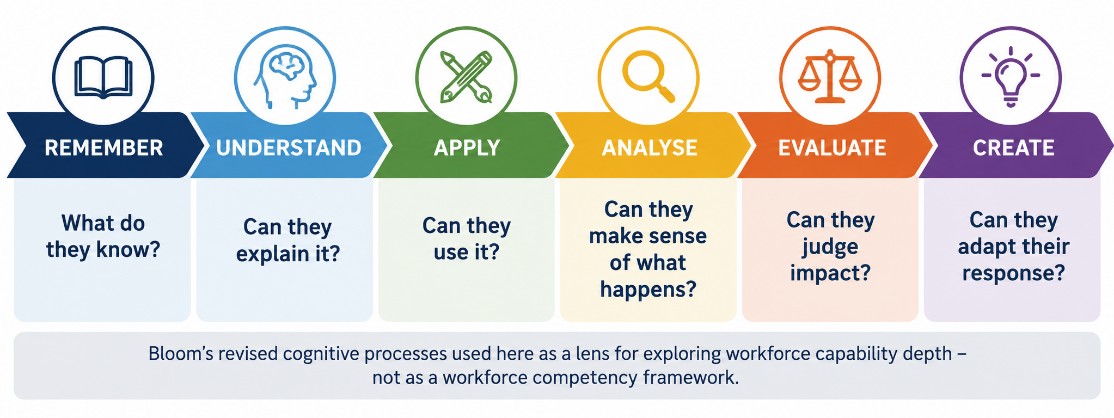
Bloom’s Taxonomy is familiar to generations of educators as a way of thinking about cognitive demand. Revised in 2001, its cognitive processes are commonly expressed as Remember, Understand, Apply, Analyse, Evaluate and Create.
It was designed to classify educational objectives, not to diagnose workforce capability. But that distinction is precisely what makes an adapted use interesting.
What happens if we use those cognitive processes not as a checklist, but as a lens through which to ask where capability begins to break down?
Because not knowing, not understanding, not being able to apply and not being able to exercise professional judgement are different problems.
Why would we expect the same development response to solve all of them?
Knowing about practice is not the same as being able to practise
Take adaptive teaching.
A practitioner may be able to remember relevant terminology, strategies or organisational expectations.
They may understand those ideas sufficiently well to explain why adapting teaching matters and how different approaches might reduce barriers to participation.
The next question is whether they can apply that understanding. Faced with a real learner, can they select and use an appropriate approach rather than simply describe one?
Then the cognitive demand changes again.
Can they analyse what is happening when the approach does not produce the expected response? Can they distinguish between a barrier associated with the task, the language being used, prior knowledge, confidence, accessibility or something else?
Can they evaluate the response they have chosen? What evidence tells them it worked? What might they do differently next time?
And can they create or adapt an alternative when the familiar strategy is not appropriate?
Suddenly, “development in adaptive teaching” looks considerably less straightforward.
Someone who:
– lacks foundational knowledge may benefit from explicit teaching and good-quality resources.
– understands the principles but struggles to apply them may need modelling, opportunities to practise and feedback.
– can apply familiar approaches but struggles to analyse what is happening may benefit more from case discussion, observation, coaching or structured professional dialogue.
– is an experienced practitioner developing evaluative judgement and may need opportunities to interrogate evidence, challenge assumptions, compare approaches and explain the reasoning behind their decisions.
The topic may be the same.
The development need is not.
This distinction between knowing and knowing how is also visible in current Department for Education guidance for further education initial teacher education. The guidance distinguishes between the knowledge and understanding trainee teachers need and their ability to use effective approaches to teaching, learning and assessment in practice.
That distinction matters well beyond initial teacher education.
But what evidence told us there was a gap?
There is an earlier question too.
What evidence led us to identify the development need in the first place?
– Was it an observation?
– Learner feedback or experience?
– Assessment outcomes?
– Self-assessment?
– A manager’s perception?
– A quality indicator?
– A repeated difficulty emerging in practice?
These sources may tell us different things.
A practitioner saying they lack confidence does not necessarily mean they lack capability. Equally, somebody expressing confidence does not demonstrate that their practice is effective.
A capability diagnosis is only as useful as the evidence beneath it.
Before asking at what depth capability begins to break down, we therefore need reasonable confidence that we have identified the right capability in the first place.
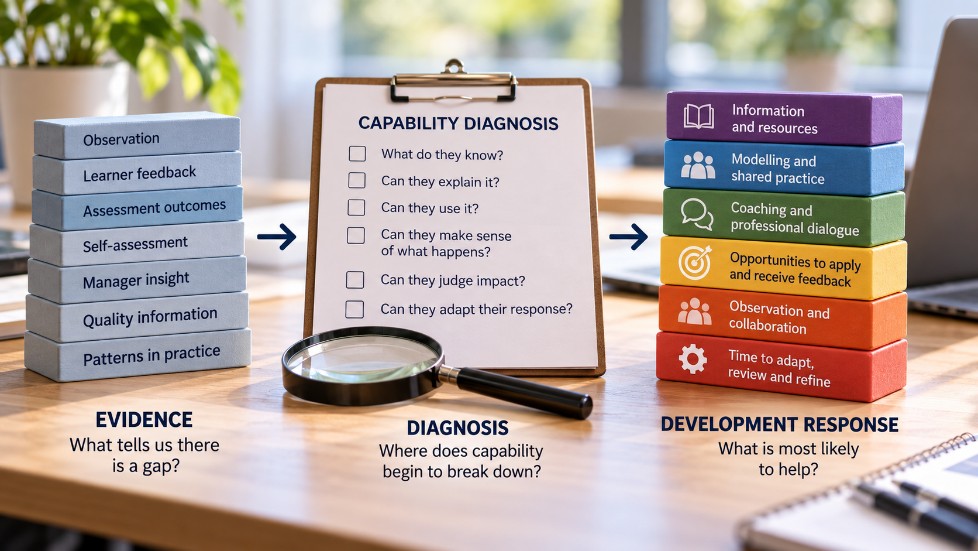
That moves the conversation beyond simply identifying a topic for CPD. It asks organisations to consider the chain between evidence, diagnosis and development response.
If any one of those is weak, the activity that follows may be well intentioned without addressing the problem we actually have.
This connects directly with The CPD Calendar Is Full. The Practice Gap Remains. There, the question was whether organisations sometimes treat an implementation problem as a knowledge problem. Here, the question moves one stage further: if there is a genuine capability gap, do we understand its depth well enough to choose the right response?
Bloom’s should not become another checklist
There is a risk here.
Bloom’s is often represented as a neat hierarchy, accompanied by lists of verbs that supposedly demonstrate increasing cognitive complexity.
Those verbs can be useful prompts. They are not evidence of cognitive depth.
Putting evaluate into a learning objective does not guarantee meaningful evaluation.
Asking somebody to analyse something does not tell us how sophisticated the analysis needs to be, what knowledge they bring to it or whether they can make appropriate use of that thinking.
The same caution applies when considering workforce capability.
– A practitioner being able to describe a strategy does not necessarily mean they can use it appropriately.
– Being able to use it once does not necessarily mean they can recognise when it is unsuitable.
– Being able to follow an established process does not automatically demonstrate the professional judgement needed to adapt it.
The Department for Education’s Powerful Pedagogy: Effective Practice provides examples from further education where questioning requires learners to retrieve knowledge, reason, explain and draw on learning accumulated over time. It reinforces an important distinction: knowledge matters, but effective learning requires more than its reproduction.
Research into effective teaching has similarly highlighted the importance of teachers’ content knowledge alongside pedagogical content knowledge, including understanding how learners think about particular content and recognising likely misconceptions.
Knowing matters. But usable capability requires us to do something with what we know.
Are we diagnosing topics when we need to diagnose capability?
Look at many development plans and the entries are expressed as topics:
– SEND.
– Assessment.
– Digital skills.
– AI.
– Maths and English.
– Employer engagement.
– Adaptive teaching.
– Safeguarding.
The topic tells us where development may be required.
It does not necessarily tell us what needs to change.
That distinction matters when the expectations placed on educators continue to expand.
We ask people not simply to:
– know about inclusion, but to recognise and respond to barriers.
– know that Maths and English matter, but to identify authentic opportunities to contextualise and reinforce them.
– use digital technology, but to decide when its use strengthens learning.
– know organisational policies, but to exercise judgement when circumstances do not fit neatly into an anticipated scenario.
– increasingly, not simply to use AI, but to question outputs, recognise limitations and decide when human judgement needs to take precedence.
If the required capability involves application, analysis and judgement, development that stops at information transfer is unlikely to be enough.
That is particularly visible in inclusion. In SEND Capability Under Pressure: Why Recognising Need Is Not the Same as Responding to It, the distinction was between identifying need and having the organisational and professional capability to turn that knowledge into responsive everyday practice. Recognition matters, but practitioners also need to interpret, respond, review the effect and adapt when an approach is not working.
Diagnose before you prescribe
This is where Bloom’s becomes useful again.
– Not as a lesson-planning template.
– Not as a hierarchy of impressive-sounding verbs.
– And not as a new workforce competency framework.
Instead, it can become a diagnostic lens.
Take one capability that matters in your organisation and ask:
– Can people describe what good practice looks like?
– Can they explain why it matters and what informs their decisions?
– Can they apply that understanding in practice?
– Can they analyse what is happening when circumstances change or something does not work as expected?
– Can they evaluate its impact and justify what they would do next?
– Can they adapt or create an appropriate response rather than simply repeat a familiar one?
Then ask the question that matters:
Where does confidence, consistency or independence begin to fall away?
The answer should influence the development response.
Some people may need knowledge. Others need practice. Some need feedback. Others may need coaching, professional dialogue, opportunities to observe colleagues, subject-specific collaboration or time to test and refine what they already understand.
That is very different from assuming everybody needs another course.
This develops the argument in The Workforce Cannot Be the Shock Absorber for Every New Ambition. There, I argued that leaders need to distinguish genuine capability gaps from problems of capacity and organisational conditions, and that we should diagnose before we prescribe. The additional challenge here is that even once we have identified a genuine capability gap, we still need to understand where within that capability the gap sits.
From development activity to usable capability
This matters beyond individual professional development.
Further education and skills organisations are being asked to respond to significant change:
– qualification and curriculum reform,
– increasingly diverse learner needs,
– changing assessment expectations,
– digital transformation,
– artificial intelligence
and evolving employer requirements.
The temptation is to respond to each new expectation with another piece of guidance, another briefing or another training session.
– But information does not automatically become understanding.
– Understanding does not automatically become application.
– Application does not automatically produce good judgement.
– And attendance does not automatically create capability.
That distinction between visible activity and meaningful impact also sits behind The Learner Journey Looks Good on Paper. But Is It Really Happening?. Whether we are looking at learner experience or workforce development, completed activity can tell us that something happened. It cannot, by itself, tell us what changed because of it.
So, the next time somebody is identified as needing development in adaptive teaching – or assessment, SEND, Maths and English, digital practice, AI or anything else – perhaps the first response should not be:
What training can we give them?
It should be:
What can they already do, where does that capability begin to break down, and what evidence tells us that?
Bloom’s Taxonomy cannot answer those questions for us.
But used thoughtfully, it can help us ask better questions.
And in a sector where the workforce cannot simply absorb every new ambition through another layer of CPD, perhaps it is time to stop prescribing development before we have properly diagnosed the need.
How Creating Excellence can help
If your organisation has identified workforce-development priorities but needs greater clarity about what capability actually needs to change, Creating Excellence can help.
We work with post-16 leaders, quality teams and practitioners to examine workforce capability, identify where knowledge, application or professional judgement is breaking down, and design professional learning that responds to the diagnosed need rather than simply adding more activity.
If you would like to discuss an organisational capability review, leadership session or tailored professional development programme, please get in touch.
About the author
Christine Edwards QTLS is an Education Strategy and Professional Learning Consultant specialising in post-16 education, apprenticeships, Maths, English and Digital capability, inclusion, curriculum and quality improvement. Through Creating Excellence, she helps organisations translate strategy, evidence and professional learning into confident, consistent practice and better learner experiences.